
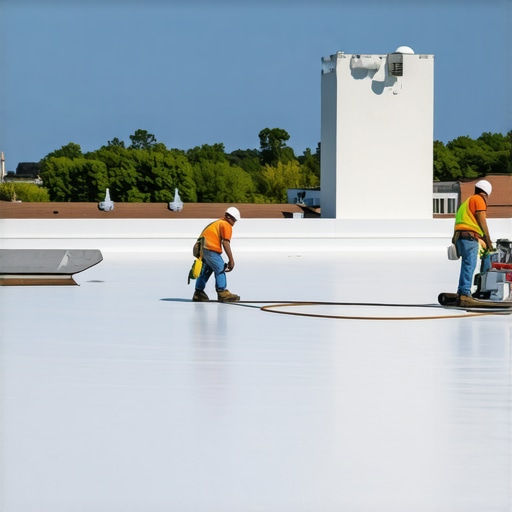
The Day the Warehouse Floor Turned into a Lake
Walking on that roof felt like walking on a giant, sun-baked sponge. I knew exactly what I’d find underneath before I even pulled my probe out of my pocket. It was a 60,000-square-foot distribution center, and the owner was losing ten grand a day in soggy cardboard and ruined electronics. From the ground, the roof looked fine. From the ladder, it looked like a standard white single-ply. But when I knelt down and ran a seam prober along the overlaps, the tool didn’t just snag—it sank. The ‘contractor’ they hired had used a contact adhesive on a PVC membrane during a humid week in October. In the trade, we call that a ‘wish and a prayer’ roof. The glue hadn’t bonded; it had just sat there until the first freeze-thaw cycle ripped the seams wide open. This is why I tell every building owner the same thing: if you aren’t welding your seams, you aren’t roofing; you’re just laying down expensive tarp paper.
The Physics of the Monolithic Bond
When we talk about PVC (Polyvinyl Chloride) in commercial roofing, the magic isn’t in the sheet itself—it’s in the molecular fusion of the seams. Unlike EPDM, which relies on seam tape and primers that eventually dry out and lose their ‘tack,’ PVC is a thermoplastic. This means we can use high-heat robots to melt two separate sheets into one continuous, monolithic membrane. When done correctly, the seam becomes the strongest part of the roof, not the weakest. This is achieved through a process called heat welding. A robotic welder crawls along the lap, injecting 1,100°F air between the layers while simultaneously compressing them with a heavy silicone roller. We aren’t just sticking things together; we are changing the physical structure of the material to create a permanent seal. This is the gold standard for roofing companies who actually plan on being in business when the warranty claim comes in ten years later.
“The quality of a low-slope roof is inversely proportional to the number of non-welded penetrations and seams it contains.” – Forensic Roofing Axiom
1. Unrivaled Water Tightness and Capillary Resistance
Water is a patient bastard. It doesn’t just fall; it migrates. Through a process called capillary action, water can actually travel uphill through tiny gaps in a glued seam. On a flat deck, water might sit for forty-eight hours after a storm. If there is a microscopic void in an adhesive bond, that standing water will find it. PVC seam welding eliminates this risk entirely. Because the two sheets are fused, there is no ‘interface’ for the water to penetrate. In cold climates where ice dams are a constant threat, this fusion is the only thing preventing melt-water from backing up under the shingles or membrane. If your local roofers are still pushing T-patches and glue on a PVC job, they are cutting corners that will eventually lead to hidden decking plywood decay. I’ve seen ‘shiners’—those missed nails—act as conduits for moisture once a seam fails, rotting out the substrate until the whole system sags.
2. Chemical and Environmental Resilience
Commercial roofs aren’t just dealing with rain; they are dealing with HVAC exhaust, kitchen grease, and chemical pollutants. Most roofing materials degrade when exposed to animal fats or harsh chemicals. PVC, however, is notoriously stubborn. This is why it’s the go-to for restaurants and food processing plants. When you weld those seams, you are ensuring that the chemical resistance of the sheet extends across the entire field. Glued seams are the first thing to dissolve when greasy exhaust hits them. A welded seam doesn’t care. It stands up to the ‘thermal shock’ of a 100-degree afternoon followed by a 40-degree thunderstorm. While other membranes are expanding and contracting at different rates than their tape, a welded PVC roof moves as a single unit. This prevents the ‘alligatoring’ and cracking seen in older built-up roofs.
3. The ‘Cold Weld’ Trap and Quality Control
Now, don’t think just because a crew has a heat gun that you’re safe. The ‘Forensic Autopsy’ of a failed PVC roof often reveals ‘cold welds.’ This happens when the technician moves too fast or the voltage to the welder drops. The material looks fused, but it’s really just a superficial ‘skin’ bond. A real pro performs a ‘pull test’ every morning. We take two scrap pieces, weld them, and then try to rip them apart once they cool. If the weld holds and the membrane itself tears, you’ve got a good bond. If the seam pops open, the settings are wrong. This level of precision is what separates high-end roofing professionals from the guys who just bought a truck and a ladder. I always recommend checking the commercial roofing PVC seam welding benefits to understand the technical requirements of a lasting install.
“A roof is only as good as its flashing, and flashing is only as good as its termination.” – The NRCA Manual (Paraphrased)
4. Long-Term Maintenance and Repairability
Nothing lasts forever, not even a perfectly welded PVC deck. Eventually, a Rooftop Unit (RTU) will be replaced, or a satellite dish will be installed by someone who doesn’t know a cricket from a curb. The beauty of PVC is that even ten years later, you can cleaned the aged membrane and weld a new patch directly to it. Try doing that with an old EPDM roof—you’ll be scrubbing with harsh solvents for hours and still might not get a bond. For property managers, this means ‘The Surgery’ (a full tear-off) can be delayed for decades with simple, welded ‘Band-Aids’ that actually work. If you notice issues near the edges, it might be related to loose roof valley seam flashing or poor termination bar installation. Always insist on a technician who knows how to ‘probe’ the entire roof perimeter annually to catch these minor openings before they turn into the ‘oatmeal’ plywood nightmares I see every winter.
The Cost of the Cheap Option
I get it. The bid for the glued EPDM or the cheap TPO is 20% lower. But in the commercial world, that 20% is just a down payment on your future disaster. When a seam fails on a warehouse, it’s never just a ‘small leak.’ It’s a systemic failure. The insulation gets saturated, loses its R-value, and starts breeding mold. Suddenly, your energy bills spike, and your tenants are complaining about the smell. Using commercial warehouse flat seam venting can help mitigate some moisture, but it won’t fix a compromised membrane. Invest in the weld. Hire roofing companies that can show you their automated equipment and their test strips. Don’t let your building become the next horror story I tell to a group of adjusters. A roof isn’t a place to save money; it’s the only thing protecting every other investment you’ve made inside those walls.