
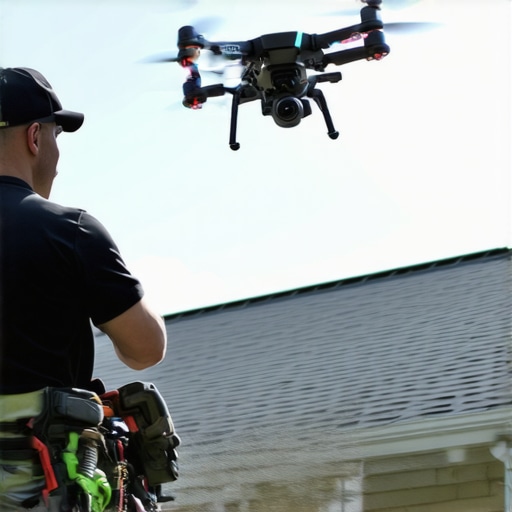
The Invisible Rot: Why Thermal Drones Are Replacing the “Wait and See” Strategy in 2026
I stood on a commercial flat roof last November in the biting dampness of a coastal morning, and everything looked fine to the naked eye. The EPDM membrane was black, tight, and seemingly secure. But walking across it felt like navigating a minefield of sponges. I knew exactly what was happening underneath that rubber skin, even if the building owner didn’t. Down in the breakroom, they were probably wondering why the air smelled like a basement, even though the ceiling tiles weren’t dripping yet. That is the fundamental problem with traditional roofing: by the time you see a brown stain on the drywall, the battle is already lost. Your insulation is saturated, your decking is soft, and your bank account is about to take a hit it didn’t prepare for.
As we move into 2026, the standard for roofing companies has shifted. We aren’t just guys with hammers and a ladder anymore; we have to be forensic investigators. The advent of high-resolution thermal drones has changed the way local roofers diagnose the health of a structure. It’s no longer about guessing where a leak starts based on the slope of a valley or the placement of a chimney. It is about physics—specifically, the physics of thermal mass and moisture entrapment.
The Physics of the “Cold Spot”: How Thermal Drones See Through Shingles
To understand why local roofers are obsessed with thermography, you have to understand how water behaves once it gets past your primary defense. Imagine a standard asphalt shingle roof. A heavy rain hits, and a small amount of water finds its way under a poorly flashed cricket. This water doesn’t just sit there; it travels. It finds a “shiner”—that’s a nail that missed the rafter and is sticking through the plywood—and follows it down like a highway. Once that water hits the fiberglass insulation in your attic, it stays there. It becomes a thermal reservoir.
During the day, the sun beats down on your roof, heating everything up to 140 or 150 degrees. When the sun goes down, dry materials like wood and asphalt lose their heat relatively quickly. But water? Water has a high thermal mass. It holds onto that heat much longer than dry plywood. Conversely, in the early morning, wet spots can appear as cold signatures due to evaporative cooling. A thermal drone flying overhead at dusk or dawn captures these temperature differentials with pinpoint accuracy. While a human inspector might see a perfectly flat, gray surface, the drone sees a bright neon signature of a moisture plume spreading six feet out from a tiny puncture. This isn’t magic; it’s science that saves homeowners from total deck replacement.
“Thermal moisture surveys provide a non-destructive method for identifying entrapped moisture within a roof system, allowing for targeted repairs rather than premature total replacement.” – National Roofing Contractors Association (NRCA) Guidelines
The Northeast Reality: Ice Dams and Thermal Bridging
In our neck of the woods, the climate is a relentless enemy. We deal with the freeze-thaw cycle that can turn a microscopic crack into a gaping hole in a single season. Thermal drones are particularly effective here because they identify “Thermal Bridging.” This is where heat is escaping from your living space into the attic, warming the roof deck and creating the perfect conditions for ice dams. If your local roofers aren’t checking for heat loss signatures, they are only fixing the symptom, not the disease.
When I’m out on a forensic call, I look for the heat leaks. If a drone shows a hot spot right above your exterior wall, I know your insulation has settled or was never installed correctly. That heat melts the snow on the roof, the water runs down to the cold eaves, and boom—you have an ice dam that backs up under the shingles. Without that thermal bird’s-eye view, a contractor might just sell you more ice and water shield. But with the data, we can tell you that you need to fix the air sealing in your attic bypasses first.
The Anatomy of a Failure: From Shiner to Structural Rot
Let’s talk about the “Mechanism of Failure.” Most people think a roof fails all at once during a hurricane. It doesn’t. It fails in millimeters over years. It starts with capillary action—the physical phenomenon where water is literally sucked upward into tight spaces, like the gaps between overlapping shingles or under flashing. Once that moisture is trapped, it begins the slow process of delaminating your plywood. In the industry, we call this “turning the deck to mush.”
By using drones, roofing companies can catch this before the wood loses its structural integrity. If we find the moisture plume early, we can perform “surgery”—removing a few squares of shingles and replacing the wet insulation and a single sheet of decking. If you wait until the ceiling falls in, you’re looking at a full tear-off, which in 2026, with material costs being what they are, is a massive capital expense. This is why the “Free Inspection” of 2010 is being replaced by the “Diagnostic Survey” of 2026. You want data, not an opinion.
“All roofs shall be sloped to provide positive drainage. Where moisture is suspected within the assembly, investigative testing shall be performed to determine the extent of the damage.” – International Residential Code (IRC), Section R908
The Trap of the “Ladderman” vs. the High-Tech Roofer
There are still plenty of “trunk slammers” out there who will show up with a ladder, walk around for ten minutes, and give you a quote. They might spot a broken shingle or some cracked caulk around a pipe boot, but they are blind to what’s happening underneath. They can’t see the R-value degradation. They can’t see the rusted fasteners that are losing their withdrawal strength because they are sitting in a damp environment 24/7. When you are vetting roofing companies, you need to ask about their diagnostic tech. If they aren’t using thermography, they are just guessing with your money.
A drone inspection also provides a permanent digital record. In 2026, insurance adjusters are becoming increasingly skeptical. If you try to claim storm damage, they want proof that the leak wasn’t a result of ten years of neglect. A thermal map provided by your local roofers acts as a “Before and After” document. It proves the state of the roof prior to a weather event, making the claims process significantly smoother. It turns a subjective argument into an objective fact.
How to Pick Your 2026 Roofing Partner
When you’re looking for local roofers, look for the ones who talk about building science, not just shingles. You want a team that understands the stack effect, vapor barriers, and the specific wind-uplift ratings required for our zone. Ask them if they provide a full thermal report. If they look at you like you have two heads, move on. The industry is changing, and the contractors who refuse to adapt are the ones who will be leave you with a leaking valley two years after they disappear. Don’t settle for a guess when you can have a forensic map of your home’s most important defense system.