
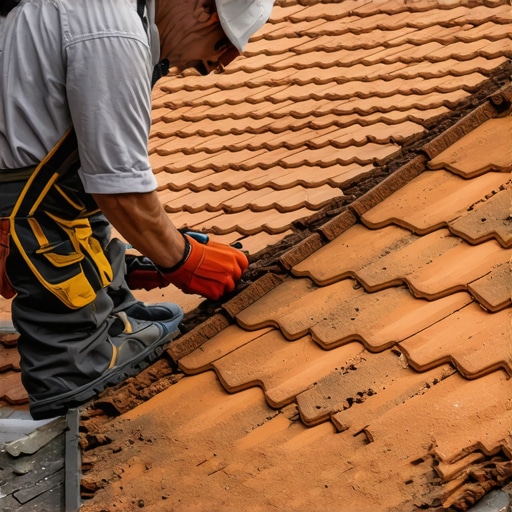
The Sound of a Ticking Time Bomb on Your Roof
You hear it before you see it. It is that rhythmic clack-clack-clack during a late-afternoon breeze—the sound of a two-pound concrete tile dancing against a wooden batten because the fastener gave up the ghost three summers ago. Most homeowners ignore it until they find a jagged piece of terracotta shattered on the driveway or, worse, a dark stain spreading across the master bedroom ceiling. As a forensic investigator who has spent two decades crawling through 140-degree attics, I can tell you that a loose tile is never just a cosmetic issue. It is a symptom of a system in the middle of a slow-motion collapse. When we talk about roofing in the desert heat, we are talking about a brutal war against thermal expansion.
“A roof is only as good as its flashing and the integrity of its primary water barrier.” – Old Roofer’s Adage
My old foreman, Big Al, used to stand on a 6:12 pitch with a weathered hammer and say, ‘Water is patient. It will wait years for you to make one mistake, then it will rot your house from the inside out.’ He was right. In our line of work, we see it constantly: local roofers who slapped a tile down with a single nail and called it a day, only for the heat of the Southwest to turn that nail into a ‘shiner.’ That is trade talk for a fastener that missed the rafter or backed out due to the constant tug-of-war between the hot sun and the cool night. By the time 2026 rolls around, the materials we installed twenty years ago are reaching their breaking point. If you want to avoid a full-scale replacement, you need to understand the physics of why your roof is literally falling apart.
The Forensic Autopsy: Why Tiles Move
Concrete and clay tiles are heavy, but they are not invincible. The primary enemy here is thermal shock. During a typical July day, your roof surface can hit 160 degrees. At night, it drops to 80. This 80-degree swing causes the tiles to expand and contract. This movement exerts hydrostatic pressure on the fasteners. Over time, the holes in the underlayment widen, the nails loosen, and the tile begins to slide. This is called ’tile slip.’ Once a tile slips, the underlayment—the actual waterproof skin of your home—is exposed to direct UV radiation. In the desert, UV light is like acid. It eats the oils out of the bitumen felt, turning it into something that resembles a burnt potato chip. Once that underlayment cracks, the next monsoon season isn’t just a rain event; it is a structural catastrophe.
Fix 1: The Mechanical Fastener Overhaul
The first way we stop the bleeding is by addressing the fasteners. The old way of doing things—using a standard galvanized nail—is failing. By 2026, the standard for any reputable roofing companies should be stainless steel or heavy-duty screw-shank fasteners. We don’t just hammer a new nail in. We look for the ‘shiners’ and the ‘misses.’ If a batten is rotted because water has been seeping through a loose tile hole, we rip that section out. We use a cricket to divert water around chimneys and wide penetrations to ensure that no water sits behind the tiles. A square of roofing—that is 100 square feet for the laypeople—requires precise fastening patterns to meet the 2026 wind uplift codes. If your contractor isn’t talking about wind uplift, fire them.
Fix 2: The High-Expansion Adhesive Bond
Sometimes, nails aren’t the answer, especially on steep slopes or in valleys where tile cuts are tricky. This is where we use specialized roof tile adhesive foam. This isn’t the stuff you buy at a big-box store to fill a gap in your baseboard. This is a two-component polyurethane foam that creates a structural bond between the tile and the underlayment or batten. The beauty of this fix is that it allows for some movement. It absorbs the thermal shock without backing out of the wood. It seals the penetration point, preventing capillary action—that’s the physics-defying way water crawls upward and sideways under your tiles during a wind-driven rainstorm. When we perform a forensic repair, we often find that tiles secured with foam stay put while the nailed-down neighbors are halfway down the roof.
“Fasteners shall be compatible with the roof covering and shall be resistant to corrosion.” – International Residential Code (IRC) R905.3.7
Fix 3: The ‘Lift and Reset’ with Hybrid Underlayment
If the tiles are loose because the underlying wood battens have turned into mulch, you are looking at a ‘Lift and Reset.’ This is the surgery of the roofing world. We carefully remove the existing tiles, stack them, and strip the roof down to the deck. We look for ‘oatmeal plywood’—that soft, punky wood that happens when a leak goes undetected for years. We replace the deck, then install a hybrid underlayment. We are moving away from the old 30-pound felt and toward synthetic, rubberized asphalt membranes that can handle the heat. These materials are self-healing, meaning if you drive a fastener through them, the material squeezes around the shank to create a gasket. This is the only way to ensure that a loose tile in 2026 doesn’t lead to a moldy ceiling in 2027.
The Cost of Hesitation
I have stood on too many decks where the homeowner said, ‘It was just one loose tile, I didn’t think it mattered.’ By the time they called me, the roofing deck was so rotted I could put my boot through it. Repairing a few loose tiles and a small section of underlayment might cost you a few hundred dollars. Replacing a collapsed roof deck, structural trusses, and moisture-damaged drywall will cost you tens of thousands. The physics don’t lie. Gravity and UV radiation are working against your home every single hour. Find local roofers who understand forensic repair, not just sales tactics. Look for the veteran who carries a moisture meter and a hawk-eye for detail, not the one who gives you a quote from his truck without ever climbing a ladder. Your roof is the only thing between your family and the elements; treat it like the complex machine it is.