
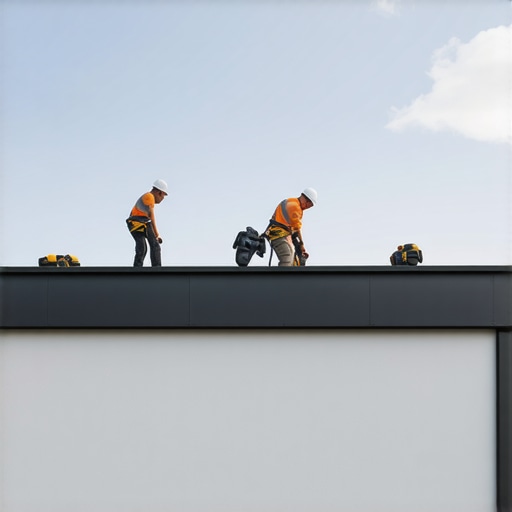
The Anatomy of a Failing Flat Roof: Why 2026 Demands More Than Just a Membrane
Walking on that roof felt like walking on a sponge. I knew exactly what I’d find underneath. It was a cold Tuesday in October, and the building manager was complaining about a ‘minor drip’ in the warehouse. As my boots sank into the saturated TPO, I could hear the rhythmic squelch-hiss of water being forced through a failed lap weld. This wasn’t just a leak; it was a forensic crime scene. The insulation was so waterlogged it had the structural integrity of wet cardboard. This is what happens when roofing companies treat a flat roof like a giant tarp rather than a high-performance chemical assembly. If you are looking at your facility’s overhead and wondering if it will survive until 2030, you need to understand the physics of failure before you sign a contract for a new square.
The Physics of the ‘Slow Death’: Why Flat Roofs Fail Early
In our northern climate, the enemy isn’t just the rain; it’s the freeze-thaw cycle and thermal bridging. A flat roof is never truly flat—or at least, it shouldn’t be. When local roofers ignore the subtle art of the cricket or the pitch of the saddles, you get ponding. Water is heavy, weighing roughly 62.4 pounds per cubic foot. When that weight sits in a depression over a structural joist, the joist deflects, the depression gets deeper, more water collects, and the cycle continues until the structural deck itself is compromised. But the real ‘ninja’ killer is capillary action. Water doesn’t just fall; it climbs. It sucks itself under loose flashing and crawls up the backside of a parapet wall, bypassing your expensive membrane entirely.
“A roof is only as good as its flashing.” – Old Roofer’s Adage
Secret 1: The Geometry of Drainage and the 48-Hour Rule
The first secret to 2026 longevity is simple: get the water off the deck. If water sits on your roof for more than 48 hours, it’s a pond. Ponding water acts as a magnifying glass for UV radiation, baking the plasticizers right out of your membrane. By 2026, the standard for any reputable roofing company will be the aggressive use of tapered insulation systems. We aren’t just laying down boards; we are building a topographical map. Every scupper and conductor head must be the lowest point of the system. If your roofer isn’t talking about 1/4-inch per foot slope, they are selling you a swimming pool, not a roof. We use crickets—small diamond-shaped diversions—to push water around curbs and HVAC units. Without them, water stacks up behind the unit, eventually finding a ‘shiner’ or a missed nail in the curb flashing.
Secret 2: Material Chemistry—TPO vs. EPDM in the Modern Era
Don’t let a salesman tell you one is ‘better’ than the other without looking at your building’s specific thermal load. TPO (Thermoplastic Polyolefin) is the darling of the industry because it’s reflective, but it has a weakness: the seams. If the welder isn’t calibrated to the ambient temperature of the morning—which might be 40°F—the bond won’t be true. By noon, when it’s 75°F, the setting must change. I’ve seen miles of TPO where the seams looked fine but could be peeled apart by hand because the ‘trunk slammer’ didn’t do a test weld. EPDM (Ethylene Propylene Diene Terpolymer), on the other hand, is a rubber beast. It handles thermal shock—the rapid expansion and contraction of a roof during a summer thunderstorm—better than almost anything. But it absorbs heat. If your cooling bills are a nightmare, EPDM might be the wrong choice unless you go with a ballasted system. The secret for 2026 is KEE-enhanced PVC or high-molecular-weight TPO that resists the molecular breakdown caused by ponding pollutants.
Secret 3: The Termination Bar and the Parapet Trap
Most leaks don’t happen in the field of the roof; they happen at the edges. I’ve performed countless autopsies where the membrane was perfect, but the termination bar—that metal strip holding the roof to the wall—was installed without a proper bead of water block. When wind-driven rain hits that parapet, it runs down the wall and ducks right behind the bar. It’s a silent killer. The secret to longevity is a redundant seal. You don’t just mechanical-fasten; you use a high-grade polyurethane sealant that remains flexible for twenty years. If your contractor is just slapping some cheap caulk on the top edge, start looking for a new one. You need a two-stage seal: one behind the membrane and one on the top of the metal counter-flashing.
“The primary function of a roof is to shed water effectively and prevent moisture from entering the building envelope.” – NRCA Manual
Secret 4: The 2026 Tech—Smart Sensors and Thermal Scans
The final secret isn’t a material; it’s a process. Longevity is born from preventative forensics. By 2026, the best roofing companies will be using infrared thermography as a standard part of their maintenance packages. Water holds heat longer than dry insulation. A thermal scan at dusk can reveal exactly where the ‘wet’ spots are before they ever show up as a drip on your desk. Fixing a ten-square-foot patch of wet polyiso insulation costs a fraction of a full tear-off. If you wait until the plywood has turned to oatmeal, you’ve already lost the war. You need a contractor who understands Vapor Drive—how moisture from inside your building tries to escape upward and gets trapped between the deck and the membrane, rotting your roof from the inside out.
Closing the Gap: How to Vet Local Roofers
Don’t ask for a ‘lifetime warranty.’ Those are often marketing fluff written by lawyers to protect the manufacturer, not you. Ask for a Workmanship Warranty. A company that stands by their lap welds and flashing details for ten years is worth five times more than a ‘lifetime’ manufacturer warranty. Look at their hands. Do they use a hand-roller on every seam? Do they probe the seams at the end of every day? If not, they are just another crew hoping the rain doesn’t start until their check clears. A flat roof is a living, breathing part of your building’s anatomy. Treat it with the forensic respect it deserves, and it will keep you dry for thirty years. Ignore the physics, and you’ll be calling me for an autopsy within five.
This article highlights some crucial points that often get overlooked during roofing projects. I really appreciate the emphasis on drainage and the 48-hour rule because, in my experience managing commercial buildings, water management is often the difference between a roof lasting 20 years versus 10. The mention of thermal scans is particularly interesting—I’ve seen cases where subtle moisture issues detected via infrared have saved a lot of hassle and expense down the line. One thing I wonder about is the balance between material choice and local climate conditions. For instance, in areas with extreme temperature swings, would you recommend KEE-enhanced PVC over high-molecular-weight TPO? Has anyone here had hands-on experience with both in similar climates and can weigh in on long-term performance? I’m eager to hear different approaches because ultimately, proactive maintenance and understanding the physics involved seem vital to preserving these roofs.