
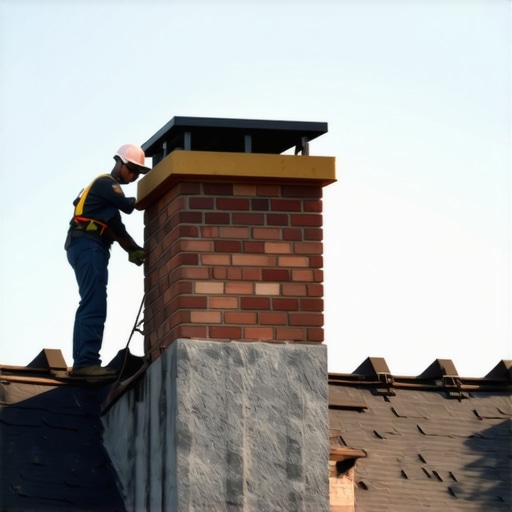
The Midnight Drip: A Forensic Post-Mortem of Your Chimney
The sound usually starts at 3:00 AM. It is not a splash; it is a steady, rhythmic thud against the drywall of your bedroom ceiling. You reach for a flashlight, and there it is—a tea-colored stain spreading across the white paint like a map of a country you never wanted to visit. Most homeowners call local roofers the next morning, expecting a quick fix. They get a guy in a truck who slaps a bucket of tar around the brick and calls it a day. Six months later, when the first heavy snowfall of the season starts to melt, that drip returns with a vengeance. As someone who has spent twenty-five years tearing off the failures of others, I can tell you that a leaking chimney is rarely about the shingles. It is an autopsy of bad physics and lazy craftsmanship.
My old foreman, a man we called ‘The Ghost’ because he could find a leak in a hurricane without getting wet, used to tell me, ‘Water is patient. It will wait for you to make a mistake. It doesn’t sleep, it doesn’t get tired, and it knows exactly where you forgot to drive a nail.’ He was right. Water doesn’t just fall down; it moves sideways through capillary action and upwards through hydrostatic pressure. If your roofing companies do not understand how water behaves at a molecular level when it hits a brick obstacle in a North/Cold climate zone, your roof is doomed before the first square is even laid.
“Flashings shall be installed in a manner that prevents moisture from entering the wall and roof through joints in copings, through moisture-permeable materials and at intersections with parapet walls and other penetrations through the roof plane.” – International Residential Code (IRC) R903.2
The Physics of the Failure: Why Chimneys Are Targets
In cold climates, a chimney is essentially a giant radiator sticking out of your house. It stays warm while the roof deck stays cold. This temperature differential creates a localized weather system. Snow hits the warm brick, melts, and runs down to the base where it meets the shingles. If the sun goes down and the temperature drops, that water freezes, expands, and pushes its way under any sealant that isn’t mechanically fastened. This is why a ‘shiner’—a nail missed by the installer that pierces the flashing—becomes a direct straw for water to enter your attic. To fix this for the long haul as we move into 2026, you need more than just a tube of caulk; you need a surgical approach to roofing.
Tip 1: The ‘Cricket’ is Not Optional
If your chimney is wider than 30 inches, the code requires a cricket. This is a small peaked structure built behind the chimney to divert water toward the valleys on either side. I have seen hundreds of local roofers skip this because it takes an extra hour of framing. Without it, you are creating a dam. Leaves, pine needles, and snow pile up in that dead space. When the water has nowhere to go, it builds up depth. Once the water level rises above the top of your vertical flashing, it is game over. A proper 2026 installation requires a cricket that is fully integrated into the roof’s primary drainage path, not just a wooden wedge slapped on top of the plywood.
Tip 2: High-Temp Ice and Water Shield Integration
Standard rubberized asphalt underlayment is great for the eaves, but it can’t handle the heat of a chimney. By 2026 standards, the best roofing companies are using high-temp-rated self-adhering membranes that wrap at least six inches up the masonry. This creates a secondary water barrier. Even if the metal flashing fails, this membrane acts as a gasket. I’ve performed tear-offs where the plywood around the chimney had turned to something resembling wet oatmeal because the contractor used cheap felt paper instead of a dedicated high-temp shield. When you’re interviewing local roofers, ask them specifically what brand of high-temp membrane they use for masonry penetrations.
Tip 3: The Reglet Cut vs. The Surface Mount
This is where most ‘trunk slammers’ fail. They screw a piece of metal to the side of the brick and run a bead of silicone along the top. In a year, the sun’s UV rays bake that silicone until it cracks, and the thermal expansion of the house pulls the metal away from the brick. A pro uses a ‘reglet’ or counter-flashing cut. We take a diamond-blade grinder and cut a one-inch deep groove directly into the mortar joint or the brick itself. The top of the metal flashing is then folded and tucked into that groove. This is a mechanical bond. Gravity works with you, not against you. Even if the sealant fails, the water will jump over the gap because it’s physically tucked into the wall. As the old adage says:
“A roof is only as good as its flashing.” – Old Roofer’s Adage
Tip 4: Step Flashing Geometry
Continuous ‘L’ flashing is for amateurs. A real pro uses step flashing—individual pieces of metal woven into every single course of shingles. This allows the roof and the chimney to move independently. Houses breathe; they expand in the summer and contract in the winter. If you use one long piece of metal, the house will eventually buckle it or pull it loose. We look for ‘kick-out’ flashing at the bottom of the chimney run to ensure water is directed away from the siding and into the gutter. If I see a roofing crew trying to use a single 10-foot piece of coil stock against a chimney, I know they aren’t thinking about the next decade; they’re thinking about the next job site.
Tip 5: The Condensation Trap (The ‘Fake’ Leak)
Sometimes the leak isn’t a leak at all. In 2026, we are seeing more energy-efficient homes that are sealed tighter than ever. If your attic ventilation is poor, warm moist air from your bathroom or kitchen travels up and hits the cold masonry of the chimney in the attic. The water vapor turns back into liquid, runs down the brick, and drips onto the ceiling. Homeowners blame the local roofers for a bad flashing job, but the real culprit is a lack of intake and exhaust vents. A forensic roofing expert will check the attic before they ever climb on the roof. They’ll look for those tell-tale rust marks on the nails—the ‘shiners’—that indicate high humidity levels rather than a flashing failure.
Hiring the Right Hands
The reality is that 90% of roofing companies are in a race to the bottom on price. To save $500, they skip the cricket, they skip the reglet cut, and they use the cheapest galvanized metal they can find that will rust through in five years. When you look for local roofers, you aren’t looking for a salesman in a shiny polo shirt; you’re looking for the guy who can explain the ‘wicking effect’ of a mortar joint. Don’t settle for a ‘Lifetime Warranty’ that only covers the shingles—those rarely fail. It’s the flashing, the valleys, and the penetrations that will eat your house alive if you let them. Invest in the metalwork today, or prepare to pay for the drywall repair tomorrow.