
The 3 AM Drip: A Forensic Autopsy of Hip Roof Failure
That rhythmic tick-tick-tick hitting the drywall in your master suite isn’t just water; it is the sound of your home’s structural integrity being liquidated. Most local roofers will show up with a tube of plastic cement and a ladder, slap a ‘Band-Aid’ on the problem, and cash your check before the next sun-scorch. But after twenty-five years of pulling apart failed systems, I can tell you that a hip roof is not just a pile of shingles; it is a complex intersection of geometry and physics where roofing companies often fail to account for the brutal reality of the Southwest climate.
My old foreman used to say, ‘Water is patient. It will wait for you to make a mistake.’ He was a grizzly guy who could smell a shiner from the driveway, and he taught me that water doesn’t just fall—it crawls. When you are dealing with a hip roof, you are dealing with four converging planes. That means four times the opportunity for a contractor to botch the flashing or miscalculate the cricket needed to divert the flow. In our 115°F summers, the materials on your roof are not just sitting there; they are expanding and contracting with enough force to shear a poorly placed fastener right out of the deck.
The Physics of the Hip Leak: Why Your ‘Lifetime Warranty’ Failed
In the 2026 landscape, we see a lot of high-tech materials, but the physics of a square of roofing remains unchanged. The primary culprit in hip roof failure is capillary action. Imagine two shingles pressed together. When a desert monsoon hits with sixty-mile-per-hour winds, the water isn’t just running down the slope. Surface tension pulls that moisture horizontally, sucking it underneath the hip cap. If your installer didn’t use a high-temp ice and water shield as a secondary barrier—a common shortcut for ‘budget’ roofing companies—that water finds the seam in your plywood and begins the slow process of turning your roof deck into oatmeal.
“A roof is only as good as its flashing.” – Old Roofer’s Adage
Then there is thermal shock. In the Southwest, a roof can hit 160°F by noon and drop to 60°F by midnight. This 100-degree swing causes the metal flashing around your chimneys and hip intersections to move. Most sealants used by local roofers dry out and crack within three years under this UV bombardment. Once that sealant fails, you have a direct conduit for moisture. We call this the ‘silent rot.’ You won’t see a puddle on the floor for years, but meanwhile, the fungus is feasting on your rafters.
The Anatomy of a Professional 2026 Repair
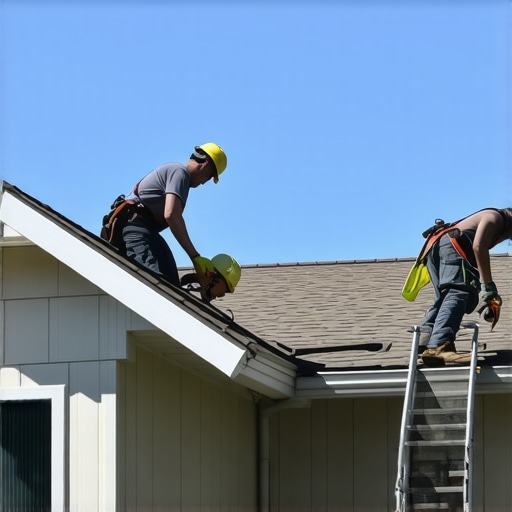
When we perform ‘the surgery’ on a hip roof, we don’t just look for the hole. We look for the path. We start by stripping back the hip caps—those are the specialized shingles that cover the junction of the two roof planes. Beneath them, we often find shiners—nails that missed the rafter and are now rusting, creating a ‘straw’ that wicks water directly into the attic. A professional 2026 fix involves removing at least two feet of shingles on either side of the hip to expose the underlying deck.
We then install a reinforced, polymer-modified bitumen underlayment. This stuff is self-healing; when you drive a nail through it, the bitumen squeezes around the shank like a gasket. Roofing in the modern era requires this level of redundancy. We don’t rely on the shingle to be the only defense; we assume the shingle will eventually fail and build a secondary waterproof roof underneath it. This is what separates a career craftsman from a ‘trunk slammer’ who is just looking to finish the square and move to the next job.
“Roofing systems must be designed to manage water, not just shed it.” – NRCA Technical Manual
The Trap: Why Your Insurance Estimate is Wrong
If you’re dealing with roofing companies after a storm, be wary of the ‘free roof’ pitch. The insurance adjuster is looking for functional damage—bruised mats or torn tabs. But a forensic investigator looks for the integrity of the valley and the hip. If the adjuster misses the fact that the UV radiation has already compromised the flexibility of the asphalt, any ‘repair’ they pay for will fail within twelve months because the old shingles will crack the moment you try to lift them to weave in new ones. This is why you need a veteran who speaks ‘adjuster’ to fight for a full replacement when the physics of the roof demand it.
Don’t let a contractor tell you that a little bit of ‘mastic’ is a permanent fix. Mastic is a temporary patch. If your hip is leaking, the internal drainage plane has been compromised. The fix is a tear-off. It’s messy, it’s loud, and it’s the only way to ensure you aren’t growing a mold colony above your children’s bedrooms. The cost of waiting is never just the price of the roof; it’s the price of the rafters, the insulation, and the drywall. In the roofing trade, the most expensive repair is the one you have to do twice.