
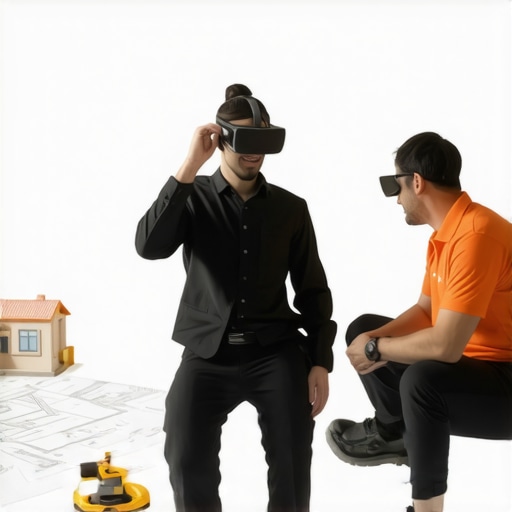
The End of the Napkin Sketch and the Rise of the Digital Twin
Twenty-five years ago, I started my career counting squares with a tape measure and sketching flashing details on the back of a greasy lunch bag. If a homeowner wanted to know how a cricket would divert water behind their oversized chimney, I had to wave my hands in the air and hope they trusted me. My old foreman used to say, ‘Water is patient. It will wait for you to make a mistake.’ He was right. Most roofing companies fail not because they can’t swing a hammer, but because they can’t visualize the physics of failure before it happens. In 2026, the industry has finally caught up to the forensics. We aren’t just selling shingles anymore; we are using Virtual Reality (VR) to show you exactly why your last roof turned into a sponge.
The Physics of the Tropical Pressure Cooker
In high-humidity zones like the Gulf Coast or Florida, the enemy isn’t just the rain; it’s the vapor drive. When it’s 95 degrees outside with 90% humidity and you’re cranking the A/C inside, your roof deck becomes a battlefield of hydrostatic pressure. I’ve walked on thousands of roofs where the plywood felt like wet cardboard because the previous guy didn’t understand thermal bridging.
“Properly designed and installed roof systems are essential for the protection of building occupants and the building’s structural integrity.” – National Roofing Contractors Association (NRCA)
By using VR client previews, local roofers can now peel back the virtual layers of your roof. We can simulate a tropical depression and show you, in real-time, how wind-driven rain doesn’t just fall—it moves sideways and up. We zoom into the starter strip to demonstrate how the lack of an offset allows water to migrate directly to the deck. This isn’t a sales tactic; it’s a forensic autopsy performed before the first shingle is even ordered.
[IMAGE_PLACEHOLDER]
Mechanism Zooming: Seeing the ‘Shiner’ Before It Happens
The most common cause of a mystery leak is the ‘shiner’—a nail that missed the rafter and sits in the attic space, sweating condensation every morning until the insulation is soaked. In a VR environment, 2026 roofing companies are using high-resolution drone scans to create a 3D mesh of your home. We can show you the exact nail pattern required for 130mph wind zones. We show the homeowner the valley construction—not just the top layer, but the ice and water shield underneath that acts as the secondary water resistance (SWR). If you can see the capillary action of water being pulled under an improperly flashed dormer in a simulation, you won’t complain about the extra $1,200 for proper metalwork. You’ll see it as the insurance policy it actually is.
The ‘Lifetime Warranty’ Trap vs. Virtual Reality
I’ve spent half my life explaining to angry homeowners why their 50-year warranty is worthless because the ventilation was choked. Most roofing companies used to hide behind fine print.
“Roof coverings shall be designed, installed and attached in accordance with this code.” – International Residential Code (IRC) Section R903.1
Now, VR allows us to run a ventilation smoke test virtually. We can show you how the air flows from the soffit to the ridge. If your attic is a 140°F oven, those shingles will cook from the inside out, turning the asphalt brittle and causing granule loss within five years. VR previews allow local roofers to demonstrate the difference between a roof that ‘looks good’ and a roof that ‘breathes.’ We compare the Uplift Ratings of different fastening methods, showing how a six-nail pattern holds up versus a four-nail pattern when the wind starts howling off the coast. It’s about moving away from ‘trust me’ to ‘let me show you the data.’
Choosing a Roofer Who Speaks Trade
If you’re talking to local roofers who aren’t using these tools in 2026, you’re hiring a dinosaur. You want someone who can show you the drip edge overlap in 3D, someone who can explain the galvanic corrosion that happens when you use the wrong flashing on a coastal home. The smell of rotting plywood is a scent you never forget, and the goal of VR is to make sure you never have to smell it. It’s about precision. When we model your roof, we calculate every square to the inch, reducing waste and ensuring that the crickets, valleys, and penetrations are armored against the elements. Don’t settle for a contractor who just talks about shingles. Demand a forensic preview. Demand to see the invisible paths water takes before it ends up on your dining room table.
This article really highlights how far the roofing industry has advanced by incorporating VR technology. I’ve seen some of these virtual previews in action, and honestly, it’s a game-changer. The ability to visualize potential water migration paths before the project even begins can prevent costly mistakes and long-term damage. I especially appreciate the focus on water flow and vapor drive, which are often overlooked but critical in humid areas like Florida. I wonder, though, how accessible these VR tools are for small, local roofers who may have limited budgets. Do you think this technology will become standard across all service levels? Personally, I believe that as the cost of VR hardware continues to drop, more contractors will adopt these forensic tools, raising the entire industry’s standards. It would be interesting to see how homeowners who experience these virtual consultations respond compared to traditional estimates—are they more confident in choosing seasoned, tech-savvy contractors? I’d love to hear how others see this shaping the future of roofing services.