
The Anatomy of a Slow-Motion Disaster
You’re sitting in your living room, the rain is drumming a steady rhythm on the roof, and then you hear it. A rhythmic tink-tink-tink inside the firebox. You think it’s just the wind, but when you look closer, there’s a dark stain blooming on the drywall above the mantle. Most homeowners call a chimney sweep, but as a forensic roofer who has spent three decades tracking water trails, I know the truth: your chimney isn’t just a vent; it’s a massive stone straw sucking moisture into the very bones of your house. My old foreman, a man who had calluses thicker than a asphalt shingle, used to say, ‘Water is patient. It will wait for you to make a mistake, and then it will wait for the seasons to finish the job.’ By 2026, the chimneys in our northern climate are facing a new breed of stress, a combination of erratic freeze-thaw cycles and aging masonry that local roofers are seeing more frequently than ever before. To understand why your roof is failing, we have to look past the surface and zoom into the mechanics of failure.
“Flashings shall be installed in a manner that prevents moisture from entering the wall and roof through joints in copings, through moisture-permeable materials and at intersections with dissimilar materials.” – International Residential Code (IRC), R903.2
1. The Spalling Cascade: When Masonry Becomes a Sponge
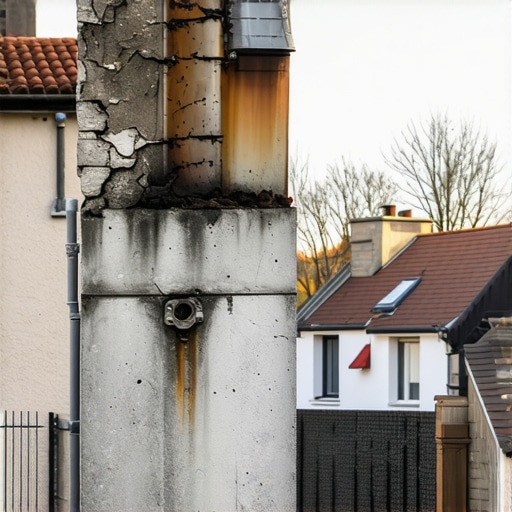
In our region, the enemy isn’t just the rain; it’s the expansion of water at the molecular level. When the temperature drops below 32°F, the moisture trapped inside your chimney’s bricks expands by roughly 9%. If those bricks are saturated because of a lack of a proper sealant or a failing crown, the face of the brick literally pops off. This is what we call spalling. By 2026, we are seeing chimneys where the brickwork looks like it’s been hit with birdshot. This isn’t just a cosmetic issue. When the hard outer ‘fire’ of the brick is lost, the soft, porous interior is exposed to the elements. It begins to soak up water through capillary action—the same physical force that pulls coffee up into a sugar cube. This moisture eventually reaches the wooden framing, or the ‘rim joist’ of your roof structure. Once that plywood becomes saturated, it loses its structural integrity. I’ve seen roofing companies try to cover this up with a bit of mastic or ‘bull,’ but that’s just a Band-Aid on a gunshot wound. You need to identify the white, powdery substance known as efflorescence; it’s the salt being pushed out of the brick by migrating moisture, and it’s a flashing neon sign that your chimney is drowning.
2. The ‘Crown of Thorns’: The Failure of the Mortar Cap
The chimney crown is the lid of your chimney. Most ‘trunk slammer’ local roofers will just slap a bit of leftover mortar on top of the bricks and call it a day. But mortar is not waterproof; it’s a bedding material. By the time we hit the 2026 season, many of these 10-year-old mortar caps have developed hairline fractures. These cracks aren’t just lines; they are canyons for water. When water enters a crack in the crown, it doesn’t just sit there. It travels downward, following the flue liner. This is where the roofing becomes forensic. You might see the damage on your ceiling three feet away from the chimney. That’s because the water hit the shoulder of the chimney, traveled along a rafter, and found a ‘shiner’—a missed nail—to drip from. A proper crown should be cast concrete with a drip edge that overhangs the brickwork, forcing water to fall away from the structure rather than trickling down the face. If your local roofer doesn’t mention the ‘overhang,’ they aren’t looking at the physics; they’re just looking at your checkbook.
“A roof is only as good as its flashing, and a chimney is only as dry as its crown.” – Old Roofer’s Adage
3. The Flashing Mirage: Why Step-Flashing Fails
The most common failure point I see is the intersection between the roof deck and the masonry. This requires a two-part system: step-flashing (which goes under the shingles) and counter-flashing (which is ‘let’ or cut into the brick). By 2026, the sealant used in these cuts often dries out and shrinks, creating a tiny gap. Through hydrostatic pressure, water is forced into that gap during heavy winds. If your chimney sits at the bottom of a long ‘valley,’ the volume of water hitting that flashing is immense. Without a ‘cricket’—a small peaked structure built behind the chimney to divert water—that chimney acts like a dam. Debris like pine needles and oak leaves collect there, holding moisture against the metal until it corrodes. Even copper, the gold standard of roofing, can fail if it’s not installed with proper expansion joints. When the sun hits a chimney, the metal expands at a different rate than the brick. This thermal bridging and expansion can tear tiny holes in the soldering. If you see rusted metal or ‘caulk’ that looks like it’s peeling, the seal is broken. You aren’t just looking at a leak; you’re looking at the slow rot of your roof deck, one square at a time.