
The Forensic Autopsy of a Spongy Eave
Walking on that roof felt like walking on a wet sponge. I knew exactly what I’d find underneath before I even pulled my pry bar from the belt. It was a late Tuesday in October, the air was crisp, but the smell coming from the gutter line was anything but—it was the cloying, earthy scent of fungus devouring structural lumber. The homeowner had been told by three different roofing companies that their leaks were just ‘clogged gutters.’ They were wrong. As I peeled back the first square of shingles, the reality was laid bare: the local roofers who installed this mess five years ago had completely ignored the physics of water migration at the edge. The plywood wasn’t just wet; it was delaminating, turning back into the wood chips it was born from. This wasn’t a product failure; it was a failure of the installer to understand how water behaves when it meets an edge.
The Physics of Failure: Capillary Action and Surface Tension
To understand why edge leaks are the silent killer of modern homes, we have to look at the ‘Mechanism Zooming’ of a single raindrop. When water hits your shingles, it doesn’t just run off like a slide. Because of surface tension, water likes to cling. It wraps around the lip of the shingle and, through capillary action, actually moves upward and backward. If your roofing system doesn’t have a properly kicked-out drip edge and a high-performance starter strip, that water is sucked directly into the gap between the fascia board and the roof deck. It’s a slow-motion disaster. In cold climates, this is exacerbated by ice dams. When heat escapes your attic—thanks to a ‘thermal bridge’—it melts the bottom layer of snow. That water runs down to the cold eave, refreezes, and creates a reservoir. That reservoir then pushes water under the shingles through hydrostatic pressure. Most ‘trunk slammers’ just throw more caulk at it. But as the old saying goes:
“A roof is only as good as its flashing.” – Old Roofer’s Adage
In 2026, we don’t rely on luck. We rely on the IRC Building Codes and advanced material science to create a literal ‘firewall’ against water. Roofing companies that know their trade are moving toward integrated eave systems that utilize self-adhering membranes (ice and water shields) that don’t just sit on the wood but chemically bond to it, sealing around every nail penetration.
The Anatomy of a 2026 Edge Solution
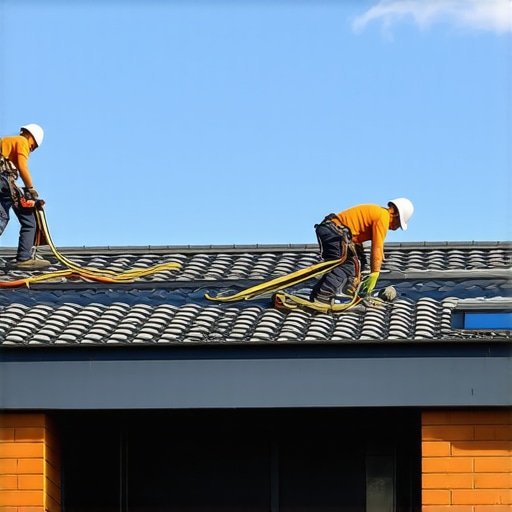
When you hire a pro, the ‘surgery’ to fix an edge leak involves more than just a few new shingles. It starts with the Drip Edge. In the old days, guys would use thin-gauge aluminum that flopped in the wind. Today, we’re looking at heavy-duty, factory-painted steel with a minimum 2-inch wide deck flange. This metal must be installed over the ice and water shield at the rakes, but under it at the eaves. Why? Because the physics of wind-driven rain demands it. If you get it backward, you’ve just built a funnel into your soffits. [image] Next, we address the Starter Strip. Most local roofers still use a cut-up shingle as a starter. That’s bush league. A true 2026 installation uses a dedicated, factory-made starter with a heavy bead of sealant at the very edge to prevent ‘shingle lift’ during a storm. If that sealant isn’t there, the wind catches the edge, creates a vacuum, and pulls the water right over the top of your drip edge.
The Shiner: The Smallest Mistake with the Biggest Price Tag
In the trade, we have a term for a missed nail: a shiner. On a standard 30-square roof, there are thousands of nails. If a roofer is moving too fast with a pneumatic gun, they’ll miss the rafter and leave a nail protruding through the underside of the deck into the attic. In the winter, that cold nail becomes a magnet for warm, moist attic air. It frosts over, then thaws, dripping onto your insulation. Over time, that ‘leak’ looks like an edge failure, but it’s actually a ventilation and fastening error. This is why we insist on R-Value consistency and proper attic bypass sealing. As the NRCA (National Roofing Contractors Association) states:
“Proper attic ventilation and moisture control are essential to the long-term performance of the roof system and the building’s energy efficiency.” – NRCA Manual
If your contractor isn’t talking about your attic’s ‘intake’ at the eaves (soffit vents) versus the ‘exhaust’ at the ridge, they aren’t a roofer—they’re a shingle flipper. Without that airflow, your eaves stay damp, and that rot we talked about earlier happens from the inside out.
The Band-Aid vs. The Surgery
I see it all the time: a homeowner pays some guy $500 to ‘seal up the edge’ with a bucket of tar. That tar will bake in the sun, crack in six months, and trap even more water against the wood. The correct fix is to tear it back to the bare wood. If the plywood is ‘oatmeal,’ it gets cut out and replaced. We then install a cricket if there’s a chimney or a wall transition nearby to divert the water away from the vulnerable edge. We don’t just ‘fix a leak’; we re-engineer the water’s path. When looking for roofing companies, ask them about their edge-metal overlap and if they use stainless nails near the coast to prevent galvanic corrosion. If they look at you like you’re speaking a foreign language, find someone else. You want the guy who’s obsessed with the 1% of the roof where 90% of the leaks happen. In 2026, a ‘lifetime warranty’ is only as good as the physics of the install. Don’t buy a warranty; buy a craftsman who knows why water is patient enough to wait for your mistake.