
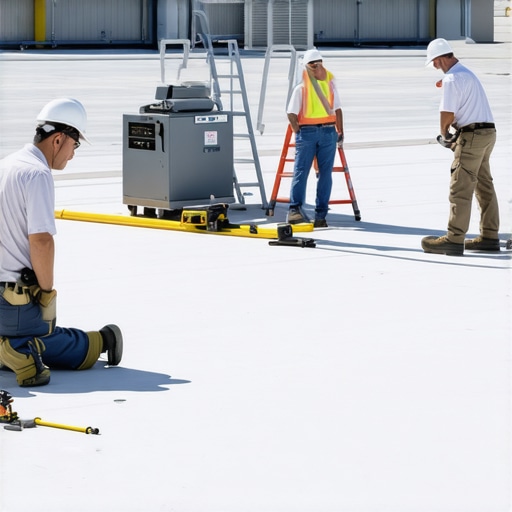
The Anatomy of a Failed Roof Drain: A Forensic Perspective
Walking on that roof felt like walking on a sponge. I knew exactly what I’d find underneath before I even pulled my knife out. It was a cold Tuesday in November, the kind of day where the dampness doesn’t just sit on your skin—it gets into your joints. This particular building owner had called three different local roofers over the last two years. Each one had slapped another gallon of silver-coated mastic around the drain and cashed their check. But the ceiling tile in the accounting office was still turning that sickening shade of tea-stain brown. When I finally cut into the membrane, the smell of rotten OSB and stagnant water hit me like a physical blow. The deck hadn’t just failed; it had disintegrated because the original roofing crew didn’t understand the physics of a clamping ring.
The Physics of Failure: Why Most Roofing Companies Get It Wrong
In the roofing industry, drains are the ultimate test of a mechanic’s skill. Any roofing companies worth their salt know that a flat roof is never truly flat—or at least it shouldn’t be. When we talk about 2026 standards, we are looking at systems that have to handle more intense, concentrated bursts of rainfall than they did thirty years ago. Most leaks at the drain aren’t actually in the pipe; they are at the transition. This is where hydrostatic pressure takes over. When water ponds around a drain because the sump wasn’t recessed properly, that water weight is constantly pushing, looking for a microscopic void in the flashing. Once it finds a shiner—a misplaced fastener—or a cold weld in the TPO, capillary action sucks that moisture horizontally under the field membrane, saturating the insulation for thirty feet in every direction.
“A roof is only as good as its flashing.” – Old Roofer’s Adage
The 2026 Approach: The Surgery vs. The Band-Aid
Most local roofers are content with the Band-Aid. They see a leak, they apply goop. In my 25 years, I’ve seen goop piled four inches thick, and it fails every single time. Why? Because the materials have different expansion and contraction rates. In our northern climate, where the temperature swings from -10°F to 90°F, that mastic cracks within one season. Real roofing professionals perform surgery. This means stripping the area back to the structural deck. We install a tapered edge strip to create a functional sump—a bowl-like depression that ensures the drain is the lowest point on the roof. If the drain flange is sitting higher than the surrounding membrane, you’ve just built a pond, not a drainage system.
Thermal Bridging and the Internal Drain Struggle
In cold climates, we deal with the ‘sweating pipe’ syndrome. Warm, moist air from the building’s interior hits the cold metal of the drain assembly. If that transition isn’t air-sealed and insulated, you get condensation that looks like a roof leak but is actually a mechanical failure. We use spray foam or heavy-duty insulation board around the drain body to break that thermal bridge. Without this, the R-value at the most critical junction of your roof is effectively zero. Modern roofing companies often skip this step because it’s hidden under the membrane. Out of sight, out of mind—until the mold starts growing in the plenum space.
“Water is patient. It will wait for you to make a mistake.” – Old Roofer’s Adage
Material Truths: TPO, EPDM, and the Clamping Ring
Whether you’re using EPDM or a heat-welded TPO, the clamping ring is the heart of the operation. I’ve seen local roofers use an impact driver to slam the bolts down on a clamping ring. That’s a rookie move. Over-tightening warps the ring, creating gaps between the bolts where water can sneak through. You torque those bolts by hand, in a star pattern, just like the lug nuts on a truck. And you never, ever rely solely on the ring. You use a water-block sealant—a butyl-based ‘death juice’ that stays tacky for decades—between the membrane and the drain flange. That is your secondary line of defense.
The Cost of Waiting
If you ignore a soft spot around a roof drain, you aren’t just looking at a patch job. You’re looking at a full-scale deck replacement. When that water sits, it eats the fasteners. It turns your polyiso insulation into a wet sponge that loses all its R-value. By the time the leak shows up on the floor, the damage is already done. A proper 2026 roofing fix involves checking the primary and secondary (overflow) drains to ensure they are clear of debris and that the cricket—the water diverter—is directing flow correctly toward the outlets. If your contractor isn’t talking about sumps and torque specs, they aren’t fixing your roof; they’re just delaying the inevitable.