
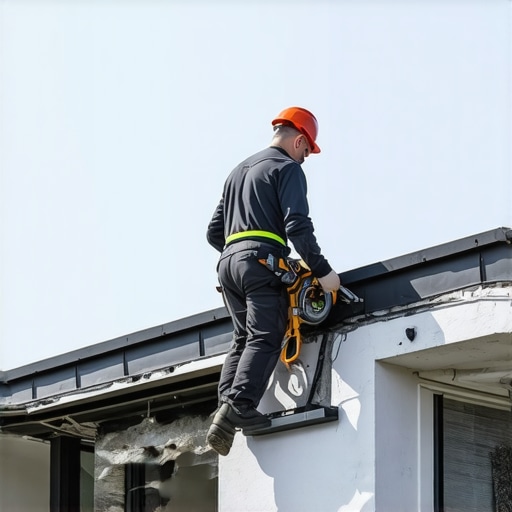
The Midnight Puddle and the 2026 Forensic Reality
The call came in at 3:00 AM—a typical time for a building owner to realize their ‘state-of-the-art’ 2026 roof system isn’t as bulletproof as the salesman promised. Walking on that roof felt like walking on a sponge. I knew exactly what I’d find underneath: the squelch of saturated polyiso insulation and the stench of stagnant water that has been trapped for months, hidden by a high-build elastomeric coating that was supposed to be ‘maintenance-free.’ Most local roofers see a leak and reach for a tube of caulk. They don’t look at the physics of why that scupper failed in the first place. In the Southwest heat, where the sun beats down at 115°F and the nights drop to 50°F, we aren’t just dealing with water; we are dealing with a thermal tug-of-war that rips poorly installed flashings to shreds.
“A roof is only as good as its flashing.” – Old Roofer’s Adage
The Anatomy of a Scupper Failure: Mechanism Zooming
To understand why roofing companies keep failing at these repairs, you have to look at the scupper sleeve itself. A scupper is essentially a metal box punched through a parapet wall. In 2026, we see a lot of fancy liquid-applied membranes, but the fundamental error remains the same: the differential expansion rates of materials. The metal scupper box expands and contracts at a rate far higher than the surrounding masonry or the roof membrane. This creates a shear force. Over time, that seal—the critical bond between the field membrane and the metal flange—fatigues. It starts as a hairline fracture, barely visible to the naked eye. Then, capillary action takes over. Water doesn’t just fall into a leak; it is pulled into it. During a heavy monsoon, the hydrostatic pressure of the water backing up against the scupper forces moisture into those microscopic gaps. Once it gets behind the flange, it’s game over for your decking.
The 2026 Material Myth
Many roofing outfits today rely too heavily on ‘super-primers’ and ‘smart coatings.’ They think they can skip the mechanical prep because the chemical data sheet says the product adheres to anything. That is a lie. When I perform a forensic autopsy on a failed scupper, I often find a ‘shiner’—a missed nail that backed out and punctured the membrane from below—or a flange that was never properly degreased. If you don’t scrub the mill oil off the metal, your fancy 2026 coating is just a temporary sticker. It will delaminate within two seasons. The heat in desert climates accelerates this process, turning the coating brittle while the metal underneath continues its violent expansion cycles.
“Scupper flanges must be set in a bed of sealant and mechanically fastened to the substrate to prevent movement-induced fatigue.” – NRCA Manual Section 4.2
The Forensic Process: Identifying the True Source
When you hire local roofers, they usually perform a visual inspection and call it a day. A forensic investigator looks for the ‘telltale signs.’ I look at the stains on the exterior of the parapet. If the leak is occurring inside the wall, the scupper sleeve itself is likely cracked at the solder joints. If the water is showing up three feet away from the scupper, we’re likely looking at a ‘cricket’ problem. A cricket is a small diverted structure built behind the scupper to direct water flow. If the slope of that cricket is too shallow, water ponds. Ponding water is the enemy of every roofing system. It creates a lens effect that magnifies UV radiation, cooking the membrane until it cracks like an old leather boot.
The Surgery: How to Actually Fix a Scupper
We don’t do ‘Band-Aids’ here. If you want a repair that lasts until 2040, you perform ‘The Surgery.’ This involves tearing out the old membrane at least two feet back from the scupper. We remove the old metal sleeve entirely. Often, the wood blocking around the opening is rotted to a pulp—what I call ‘black custard.’ We replace that wood, install a custom-fabricated 24-gauge stainless steel scupper with fully soldered seams, and prime the flange. Then, we integrate it into the roof system using a reinforced flashing detail. We don’t just glue it; we weld it or use a multi-stage reinforced cold-applied liquid flashing that can handle the 140°F roof temperatures without losing elasticity. This ensures that when the metal moves, the flashing moves with it, rather than fighting against it.
The Cost of Cheap Contractors
The tragedy I see every week is a building owner who paid a ‘trunk slammer’ $500 to smear mastic around a leak, only to end up paying me $15,000 six months later to replace a collapsed section of the roof deck. A ‘square’ of roofing—100 square feet—is expensive, but structural repair is astronomical. If your roofing companies aren’t talking about thermal expansion, hydrostatic pressure, or capillary creep, they aren’t fixing your roof; they’re just delaying the inevitable. You need someone who understands the trade, someone who has spent decades smelling the hot asphalt and feeling the vibration of a deck that’s about to give way. Don’t wait until the water is dripping on your server rack or your dining table. A scupper leak is a warning shot. Listen to it.