
The 140-Degree Attic and the Death of the Adhesive Era
I’ve spent three decades staring at roof decks that look like they were put together by someone who learned the trade from a YouTube short. My old foreman used to say, ‘Water is patient. It will wait for you to make a mistake, then it will sit in that mistake until your plywood turns into a mushroom farm.’ He wasn’t lying. By the time 2026 rolled around, the industry hit a breaking point. The ‘cheap and fast’ methods—gluing membranes down with adhesives that fail the moment the temperature swings 40 degrees—have left a trail of angry homeowners and bankrupt local roofers. That is exactly why we are seeing a massive pivot toward ballasted systems. It isn’t a new technology; it’s a return to physics. When you’re standing on a flat roof in the dead of a Northern winter, listening to the wind try to rip the coping off the parapet, you realize that weight isn’t your enemy—it’s your only friend.
The Mechanics of Gravity Over Glue
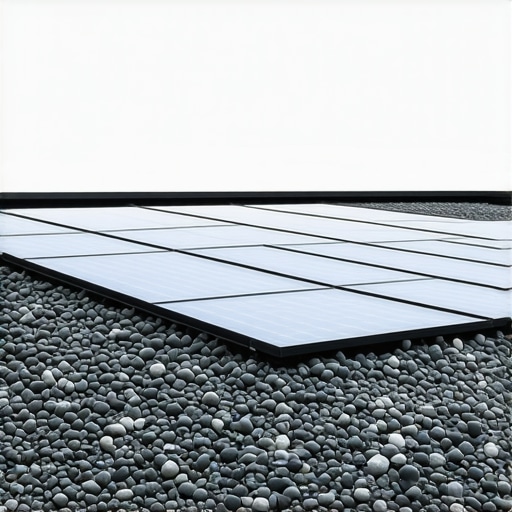
In a ballasted system, the roofing membrane—usually a heavy-duty EPDM or a reinforced TPO—is laid loose over the insulation. It isn’t poked with ten thousand screws or smeared with volatile organic compounds (VOCs) that smell like a chemical plant. Instead, it’s held in place by weight: usually round river rock or concrete pavers. If you talk to most roofing companies today, they’ll tell you it’s about speed. They’re wrong. It’s about thermal bridging and expansion cycles. When a local roofer mechanically attaches a roof, every single screw is a tiny straw of cold. In a climate like Chicago or Buffalo, that screw becomes a frost point. Condensation forms on the bottom of the screw head, drips onto the deck, and over five years, you’ve got a rotted square of wood that feels like a sponge under your boots. A ballasted system eliminates those thousands of penetrations. You aren’t fighting the building’s natural movement; you’re letting it breathe under a blanket of stone.
“Ballasted roof systems have a long history of providing excellent performance in various climates, particularly when considering wind uplift and fire resistance.” – NRCA (National Roofing Contractors Association)
The Scouring Effect: Why Your Roof Fails in the Wind
Most people think wind blows a roof off. It doesn’t. Wind creates a vacuum that sucks the roof up. This is the same lift that keeps an airplane in the sky, and it’s the same force that turns a poorly installed roof into a giant sail. In 2026, roofing companies are moving to ballast because it handles the ‘scouring effect’ better than any adhesive. When wind hits the edge of a building, it creates turbulence. We use a cricket to divert water, but we use rock size to divert wind. By placing larger stones or heavy pavers at the corners and perimeters, we neutralize that vortex. You aren’t relying on a thin layer of glue to hold back 90 mph gusts; you’re relying on the weight of the earth. If you’ve ever seen a membrane ‘flutter’ during a storm, you’ve heard the sound of the fasteners slowly backing out of the deck. That’s a shiner waiting to happen—a missed nail or a backed-out screw that eventually punctures the membrane from the bottom up. Ballast doesn’t have that failure point.
The Hidden Enemy: UV Degradation and Thermal Shock
The sun is a slow-motion fire. On a typical 90-degree day, a black EPDM roof can reach 160 degrees. That heat doesn’t just sit there; it migrates into your insulation, through your deck, and into your living space. This is where the ‘Forensic’ side of roofing gets interesting. When you peel back a ballasted roof after 20 years, the membrane underneath looks brand new. Why? Because the rock acts as a 100% UV shield. It also acts as a thermal heat sink. The stones soak up the energy during the day and release it slowly at night, preventing thermal shock—the rapid expansion and contraction that cracks flashings and tears apart valleys. 2026 roofing standards are finally catching up to the fact that ‘white roofs’ get dirty and lose their reflectivity within two years. Rock stays rock forever.
“Roofing assemblies shall be designed to resist the wind loads… Ballasted low-slope roofs shall be designed in accordance with ANSI/SPRI RP-4.” – International Building Code (IBC)
The Trap: The ‘Lifetime Warranty’ and Maintenance
Don’t let a slick salesman from one of those ‘storm chaser’ roofing companies tell you that a ballasted roof is maintenance-free. That’s a lie. While the membrane is protected, the drainage system is under constant attack. Silt and fines from the rocks can migrate toward the scuppers and drains. If your roofer didn’t install a proper filter fabric between the rock and the membrane, you’re going to have a pond on your roof by year ten. When the water can’t get off the roof, hydrostatic pressure kicks in. Water is heavy—about 62 pounds per cubic foot. If it pools, it will find a microscopic hole in your flashing and push its way through. This is why you hire local roofers who understand the specific vegetation and debris of your area. You need someone who knows that a certain type of tree nearby will clog your drainage in six months if you don’t have the right guards in place.
The Forensic Verdict: Surgery vs. Band-Aids
When I walk a roof that’s failing, the first thing I look at is the perimeter. If I see the membrane pulling away from the walls, it’s a sign of ‘membrane creep.’ Adhered systems are notorious for this as the glue dries out and the material shrinks. In a ballasted setup, the weight keeps everything pinned. If you’re choosing between a cheap shingle job and a ballasted system for a low-slope application, remember this: the cost of the ‘surgery’ to replace a rotted deck far outweighs the initial investment in a system that respects the laws of physics. Stop looking for a ‘game-changer’ and start looking for a contractor who isn’t afraid of a little manual labor and a lot of stone. Your attic—and your wallet—will thank you when the next big storm rolls through and your roof doesn’t even flinch.