
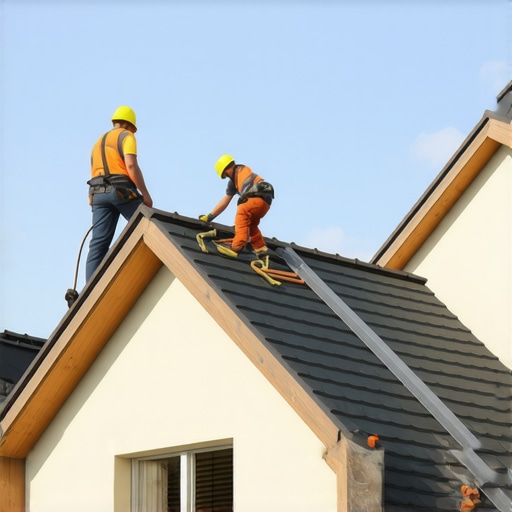
The 140-Degree Autopsy: Why Most Roof Coatings Fail Before the Check Clears
Walking on that commercial roof in the middle of July felt exactly like walking on a giant, sun-baked sponge. I knew precisely what I would find underneath before I even pulled my knife. The surface looked okay from the ladder—a bright, shimmering silver—but as soon as my boots hit the deck, the ‘crunch’ gave it away. The previous contractor had sprayed a cheap acrylic over an uncleaned, oil-saturated substrate. The heat had turned the trapped moisture into steam, creating thousands of tiny pressurized pockets that literally delaminated the coating from the roof. This wasn’t a roofing system anymore; it was a giant, expensive blister waiting to pop. That is the reality of hiring roofing companies that treat coatings like a fresh coat of house paint rather than a complex chemical membrane.
When you are looking for local roofers in 2026, you aren’t just looking for someone with a truck and a sprayer. You are looking for a forensic analyst who understands the brutal physics of thermal shock and UV degradation. In desert climates like ours, your roof isn’t just sitting there. It is breathing, expanding, and contracting with enough force to snap mechanical fasteners. If your roof coating doesn’t have the elongation properties to handle a 50-degree temperature swing in three hours, it will crack. Once it cracks, capillary action takes over, sucking monsoon rain sideways under the membrane through a process known as hydrostatic suction. By the time you see a brown spot on the ceiling, the plywood is already the consistency of wet cardboard.
“Proper surface preparation is more critical to the success of a roof coating than the material itself. Without it, adhesion is purely accidental.” – Modern Roofing Axiom
1. What is the Volume of Solids, and Why Are You Selling Me Water?
This is the first thing I ask every ‘pro’ who walks into my office. Most cheap coatings you find at big-box stores or from low-bid roofing companies are 50% water or solvent. You buy a 5-gallon bucket, and by the time it cures, 2.5 gallons have evaporated into the atmosphere. You are left with a thin, brittle film that won’t last three seasons. A real 2026 professional uses high-solids silicone or advanced urethanes with 90% or higher solids by volume. We talk in terms of ‘mils’—that’s a thousandth of an inch. If your contractor can’t tell you the target dry mil thickness they are aiming for per square, they are just guessing. A ‘square’ is 100 square feet of roofing, and if they aren’t calculating the spread rate based on the porosity of your specific deck, you are getting fleeced. You need enough ‘build’ to bridge the microscopic fissures in the old material, or you’re just coloring the failure silver.
2. Will You Perform a Pull-Test Before We Sign?
I’ve seen too many local roofers skip this because they’re afraid of what they’ll find. A pull-test involves applying a small patch of the proposed coating with a mesh reinforcement, letting it cure, and then using a scale to measure exactly how many pounds of force it takes to rip it off. If the coating peels off like a sticker, the roof is too contaminated with oils or ‘alligatored’ asphalt to accept the new membrane. In those cases, you need a primer or a complete tear-off. If a contractor tells you their product ‘sticks to everything,’ they are lying to you. Even the best silicone will fail if it’s applied over a ‘shiner’—a missed nail that’s backed out and created a puncture point. We look for those defects first, because a coating is a shield, not a structural fix.
3. How Do You Handle the ‘Cricket’ and the Drainage Physics?
Water is patient. It will find the one spot where your roof sags and wait there until the chemicals in your coating begin to break down through a process called ponding water degradation. Most roofing companies will tell you their coating is waterproof, and technically, it is. But many coatings are not rated for ‘continuous immersion.’ If you have a low spot behind a chimney or a poorly designed cricket—that’s the small peaked structure designed to divert water—and the water sits there for more than 48 hours, it will eventually emulsify the coating. You need to know if the contractor is going to level those low spots with a poly-filler or if they are just going to spray over the problem and leave you with a pond on your house.
“A roof is only as good as its flashing and its ability to shed water, not just hold it.” – National Roofing Contractors Association (NRCA) Manual
4. Is This a ‘Breathable’ Membrane?
This is where the physics gets interesting. Your house generates moisture—showers, cooking, even breathing. In a cold climate, that moisture moves up into the attic. If you seal the top of the roof with a non-breathable vapor barrier, that moisture gets trapped in the insulation and the roof deck. I’ve seen 20-year-old plywood that looked brand new on top but was completely rotted from the bottom up because the roof couldn’t ‘breathe.’ You need to ask about the ‘perm rating.’ You want a coating that keeps the liquid rain out but allows water vapor to escape. This prevents the ‘greenhouse effect’ in your attic that leads to mold growth and the structural failure of your rafters. If they don’t know what a perm rating is, show them the door.
5. What is the Real-World Elongation Percentage?
In the desert, roofs are dynamic. Between the 2 p.m. sun and a 6 p.m. thunderstorm, the surface temperature can drop 60 degrees in minutes. This is called thermal shock. The materials literally shrink. If your coating has an elongation of 200%, it might sound like a lot, but for a roof that’s already stressed, it’s the bare minimum. Top-tier 2026 coatings offer 400% to 600% elongation. This means the coating can stretch to six times its original length without snapping. Without this, the coating will develop ‘spider cracks’ over every seam and joint in your roof. Once those cracks appear, UV radiation gets into the substrate and begins to bake the oils out of your underlying asphalt, turning your expensive roof into a pile of dust and gravel. Don’t settle for ‘paint’; demand a monolithic membrane that moves with your home.