
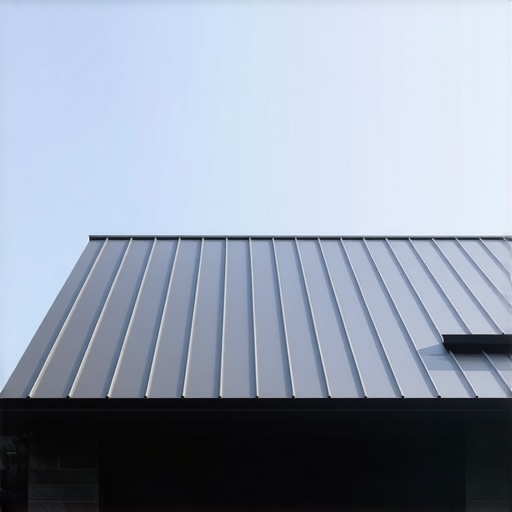
The Living Skin of the Modern Roof
I’ve spent three decades climbing ladders, and if there’s one thing I’ve learned, it’s that most homeowners think a roof is a static object. They see it as a shield that just sits there, taking a beating until it dies. But when you start talking about the 2026 shift toward zinc accents, you aren’t just talking about another piece of metal. You’re talking about a living, breathing chemical reaction that actually heals itself. My old mentor, a guy named Miller who could smell a leak from the curb, used to tell me, ‘Metal isn’t just a cover; it’s a conversation with the atmosphere.’ He was right. Zinc doesn’t just sit on your gables or valleys; it evolves. In the humid, salt-heavy air of our coastal corridors, standard materials surrender. They rust, they peel, and they eventually let the moisture win. But zinc? It has a trick up its sleeve called the patina. This isn’t just a color change. As the zinc reacts with moisture and carbon dioxide, it forms a protective layer of zinc carbonate. This layer is insoluble and incredibly dense. If a branch scrapes your zinc valley, the metal doesn’t just sit there exposed. Over time, that scratch actually heals as the patina reforms. It’s like a skin that refuses to stay scarred.
“Metals in contact with one another shall be chemically compatible or shall be separated by a material that will inhibit electrolytic action.” – International Residential Code (IRC), Section R903.4
1. The End of the Algae War: Natural Toxicity
If you live in a high-humidity zone, you know the ‘black streaks’ of Gloeocapsa magma—the airborne algae that eats the limestone filler in modern asphalt shingles. Local roofers spend half their time explaining to homeowners that their roof isn’t ‘dirty,’ it’s being eaten alive. Zinc accents provide a forensic solution to this biological problem. When rainwater hits a zinc ridge cap or a zinc-lined valley, it picks up trace amounts of zinc ions. As that water washes down the rest of the roof, it creates an environment that is toxic to algae and moss. You don’t need a pressure washer or harsh chemicals. You just need physics. The zinc ions disrupt the cellular structure of the algae, keeping your ‘squares’ looking clean for decades. It’s a passive defense system that most roofing companies won’t tell you about because they’d rather sell you a cleaning contract every three years. When we install these accents, we’re looking at the long game—not just the next storm cycle.
2. Thermal Resilience and the ‘Oil Canning’ Myth
One of the biggest fears people have with metal is ‘oil canning’—that wavy, distorted look that happens when metal expands and contracts. But here’s the trade secret: zinc has a different molecular density than your standard thin-gauge steel. In the 2026 architectural landscape, we’re seeing ‘floating cleat’ systems that allow zinc accents to move without buckling. This is vital in regions where the daytime heat on a roof can hit 160°F and then drop 40 degrees in a single rainstorm. This ‘thermal shock’ is what kills cheap flashings and tears ‘shiners’—those missed nails—out of the plywood deck. Zinc is remarkably ductile. It can be bent, hemmed, and tucked into tight corners around chimneys and crickets without cracking. It handles the expansion better than copper and far better than aluminum. When local roofers use zinc for critical transitions, they are reducing the risk of fatigue-related failures that lead to those ‘mystery leaks’ that show up in the middle of a ceiling three years after the roof was installed.
“A roof is not a single surface but a system of managed transitions where materials must be allowed to move independently.” – NRCA Manual of Low-Slope and Steep-Slope Roofing
3. The 100-Year ROI: Beyond Marketing Warranties
I get cynical when I hear the words ‘Lifetime Warranty.’ In the roofing world, ‘Lifetime’ usually means the life of the company, which is often about five years for some of these ‘trunk slammers.’ Zinc, however, is a generational material. We are seeing architectural zinc installations from the 19th century in Europe that are still shedding water effectively. In the 2026 market, homeowners are finally moving away from the ‘replace every 15 years’ cycle of asphalt. Zinc accents on high-wear areas like valleys, eaves, and ridges provide a secondary water resistance that stays intact long after the surrounding shingles have started to lose their granules. When you look at the forensic failure of a roof, it almost always starts at the valley or the flashing. By upgrading these specific zones to zinc, you’re hardening the most vulnerable points of the structure. It’s the difference between buying a pair of boots with a reinforced toe or buying a whole new pair every six months because the tip wore out. Local roofers who know their craft will tell you that the upfront cost of zinc is a drop in the bucket compared to the cost of a full interior remediation after a valley failure.
The Trap: Why Experience Matters
Don’t be fooled—zinc is a diva if you don’t know how to handle it. You can’t just slap it on with galvanized nails and call it a day. That’s how you get galvanic corrosion, where two dissimilar metals literally eat each other through an electrochemical process. I’ve walked onto jobs where a ‘local roofer’ used steel nails on a zinc sheet, and within two years, the nails had rusted into dust, leaving the metal to flap in the wind. A real pro uses stainless steel fasteners and understands the need for an underlayment that provides a ‘capillary break.’ If moisture gets trapped under the zinc without a way to evaporate, you get ‘white rust,’ a powdery corrosion that eats the metal from the bottom up. This is why you don’t hire the guy with the lowest bid; you hire the guy who has a sheet metal brake in his truck and knows how to use it. A zinc roof accent is a precision instrument, and it requires a forensic eye to ensure it actually performs for the next century.