
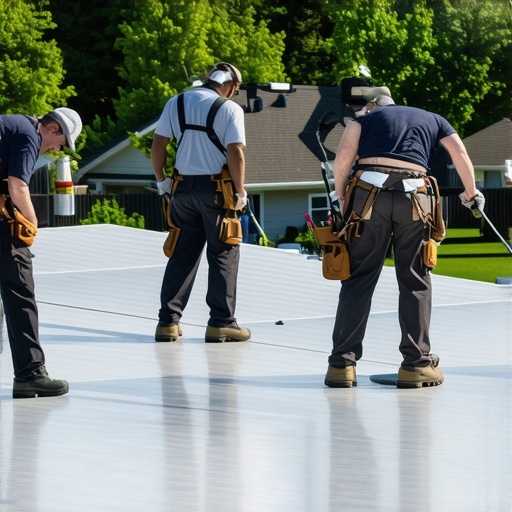
The 140-Degree Attic Reality
Walk onto a roof in the middle of July in a place like Phoenix or Las Vegas, and you aren’t just standing on a shelter; you are standing on a frying pan. I have spent 25 years watching local roofers slap down standard 3-tab shingles that start curling within five seasons because they weren’t built for this kind of thermal abuse. My old mentor, a grizzly guy who could smell a leak from the curb, used to say, ‘Water is patient, but the sun is a predator. It will wait for one weak seam to bake the life out of your decking.’ He was right. That smell of roasting asphalt and the sight of baked-out felt paper turning into cornflakes is why the industry is finally shifting. By 2026, the demand for reflective roofing isn’t just a trend; it’s a survival tactic for your HVAC system.
The Physics of Thermal Shock
Most homeowners think a roof fails because of a single storm. More often, it is the silent killer: thermal expansion. In the desert Southwest, your roof surface can swing from 160°F in the afternoon to 60°F at night. This constant expansion and contraction puts immense stress on every nail. If a roofer left a shiner—one of those missed nails hanging through the plywood—it becomes a conductive needle, pulling heat or cold directly into your attic. This cycling eventually pulls the nails right out of the wood, a process we call ‘nail back-out.’ Reflective roofs, or ‘cool roofs,’ use specialized granules that bounce short-wave infrared radiation back into the sky before it can be absorbed by the asphalt mat. We aren’t just talking about a different color; we are talking about different chemistry at the molecular level.
“The assembly of the roof shall be designed and installed in accordance with this code and the manufacturer’s installation instructions.” – International Building Code (IBC) Section 1501.1
The ‘Lifetime’ Warranty Trap
When roofing companies pitch you a ‘Lifetime Warranty,’ you need to read the fine print with a magnifying glass. Usually, that warranty is heavily prorated after the first decade, and it almost never covers ‘thermal degradation’ if your attic isn’t vented to the exact square inch of the manufacturer’s spec. I’ve seen roofing jobs where the contractor ignored the cricket—that small peaked structure behind a chimney—causing water to pool and heat to intensify in a dead-air pocket. No warranty on earth covers poor geometry. The 2026 reflective materials are different because they are being engineered to meet stricter SRI (Solar Reflectance Index) ratings, forcing manufacturers to use higher-quality polymers that don’t go brittle after five years of UV exposure.
The Anatomy of a Square: Why 2026 Tech is Different
In the trade, we talk in squares—100 square feet of material. A traditional square of shingles is basically a sponge for heat. The new 2026 reflective standards require a high level of thermal emittance. This is the ability of the material to radiate absorbed heat. If you’ve ever walked on a roof at midnight and felt heat radiating off the shingles like a toaster oven, you’re witnessing low emittance. Modern local roofers are now installing systems that stay within 10 to 15 degrees of the ambient air temperature. This prevents the plywood underneath from reaching those ‘oatmeal’ consistency levels where the glue fails and the wood delaminates. You don’t want to be the guy paying for a full deck replacement because you saved five hundred bucks on cheap shingles.
“A roof is only as good as its flashing.” – Old Roofer’s Adage
The Local Roofer Scrutiny
Not every roofing crew is ready for this shift. The ‘trunk slammers’ who show up with a ladder and a bucket of mastic are going to struggle with the 2026 codes. Reflective systems often require specific underlayments that don’t act as a vapor barrier in the wrong climate zone. If you trap moisture between a reflective shingle and a non-breathable underlayment, you’ve just built a mold factory. You need a contractor who understands the valley dynamics—where two roof planes meet—and how to flash those areas so they don’t become the weakest link in the thermal chain. High-end roofing companies are now using drone-mounted thermal cameras to prove the efficiency of these reflective installs, showing homeowners exactly where the heat is being rejected.
Is the Investment Worth the Square Footage?
The upfront cost of a 2026-spec reflective roof is higher. There is no way around the math. But when you factor in the reduction in ‘thermal shock’—which doubles the actual lifespan of the asphalt mat—and the lower cooling loads on your AC compressor, the ‘expensive’ roof is actually the cheaper one over fifteen years. I’ve spent too many days in 140°F attics looking at shiners and rotten valleys to believe in shortcuts. If you want a roof that actually protects your home, you stop looking at the price per square and start looking at the SRI rating and the quality of the ventilation. Don’t let a salesman talk you into 20th-century tech for a 21st-century climate.
I found this post incredibly insightful, especially the parts about thermal expansion and the importance of high SRI ratings for reflectivity. Having worked on roofing projects in the Southwest, I can confirm that if the underlayment and flashing aren’t properly installed, no amount of reflective shingles will save the roof in the long run. The focus on the chemisty at the molecular level for these 2026 standards also adds a fascinating layer to the decision-making process. One thing I’ve noticed is that homeowner awareness is slowly increasing, but many still overlook the importance of proper attic ventilation and vapor barriers when choosing reflective systems. Has anyone here successfully navigated the challenge of finding contractors who fully understand and implement these new standards? I’m curious about their experiences, especially in regions where some of these new tech might still be less familiar.