
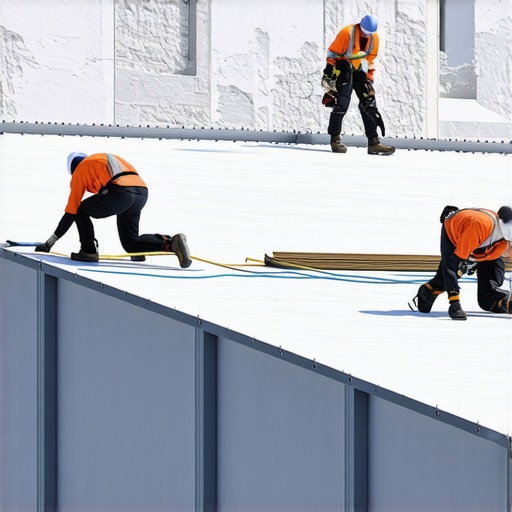
The Spongy Reality of Low-Slope Failure
Walking on that low-slope deck in the damp chill of a November morning felt exactly like walking on a giant, waterlogged sponge. Every heavy step resulted in a sickening ‘squish’ that sent a plume of dirty, grey water up through a failed seam in the TPO membrane. I knew exactly what I’d find underneath before I even pulled my knife out. The local roofers who installed this three years ago hadn’t accounted for the simple physics of dew point. They’d slapped down a single layer of polyiso, screwed it tight with metal fasteners, and called it a day. Now, the insulation boards were curled like wet potato chips, and the R-value was effectively zero. This is the graveyard of bad roofing, where physics meets incompetence.
The Anatomy of Thermal Bridging
In 2026, the best roofing companies have finally stopped pretending that a single layer of insulation is enough. When you drive a steel screw through two inches of polyisocyanurate directly into a steel deck, you’ve created a thermal highway. In cold climates, that screw head becomes a cold spot on the underside of the roof. Warm, moist interior air hits that cold metal, condenses, and drips. Over a thousand fasteners in a single square, you aren’t just looking at a leak; you’re looking at a self-generated rainstorm inside the building envelope. This is known as thermal bridging, and it is the silent killer of low-slope systems.
“Thermal bridges can result in a significant reduction in the effective R-value of the roof assembly, sometimes by as much as 20% to 30% if not properly mitigated.” – NRCA Manual for Low-Slope Roof Systems
The Physics of the 2026 Multi-Layer Standard
Today’s high-end roofing contractors are moving toward a staggered-joint, two-layer approach. Instead of one four-inch board, we install two two-inch boards. The second layer is offset so that no vertical seam goes from the membrane to the deck. Better yet, we’ve moved toward low-rise foam adhesives instead of mechanical fasteners. When you eliminate the ‘shiners’—those missed or exposed nails that provide a path for heat and water—you create a continuous thermal barrier. This isn’t just about saving on the heating bill; it’s about keeping the dew point outside of your structural deck so the plywood doesn’t turn into a mushroom farm.
Tapered Systems: Fighting the Physics of Ponding
Water is patient. It will wait for the smallest structural deflection to find a home. Many roofing companies fail because they ignore the ‘1/4-inch rule.’ If a roof doesn’t have a built-in structural slope, we have to build it with insulation. This is the tapered system. We use factory-cut blocks of polyiso that gradually increase in thickness, directing every drop of water toward the drains or scuppers. I’ve seen too many ‘cheap’ quotes where the contractor skips the crickets—those small diamond-shaped peaks behind chimneys or HVAC units. Without a cricket, water stacks up, hydrostatic pressure builds, and eventually, that water is coming inside.
“Roof systems shall be sloped a minimum of one-fourth unit vertical in 12 units horizontal (2-percent slope) for drainage.” – International Residential Code (IRC), Section R905.1
The Material Truth: Polyiso vs. XPS vs. EPS
Don’t let a salesman tell you all insulation is the same. Polyisocyanurate (Polyiso) is the king of the low-slope world because of its high R-value per inch, but it has a dark secret: its performance drops as the temperature falls. In 2026, we are seeing a shift toward hybrid systems. We might use a base layer of Expanded Polystyrene (EPS) for stable R-value and top it with a high-density cover board. That cover board is the ‘armor.’ It protects the soft insulation from hail and the boots of HVAC technicians who treat your roof like a sidewalk. If your roofer isn’t talking about cover boards, they are selling you a roof that won’t last ten years.
The Warranty Trap
I’ve spent 25 years watching ‘Lifetime Warranties’ vanish as fast as the companies that issued them. In the roofing world, a warranty is often just a piece of paper designed to make you feel good while the contractor cashes your check. Most manufacturer warranties only cover the membrane, not the labor to replace the sodden insulation underneath. When selecting between roofing companies, ask about their ‘workmanship’ warranty and their track record for forensic repairs. If they don’t understand the capillary action of water moving sideways under a loose-laid lap, they shouldn’t be touching your deck.
Conclusion: The Cost of Cheap
Roofing is the only part of a building that is constantly under attack from UV radiation, thermal shock, and gravity. In 2026, the technology exists to make a low-slope roof last thirty years, but it requires more than just a roll of rubber and some glue. It requires an understanding of thermodynamics and a refusal to cut corners on the ‘invisible’ parts of the roof. Pay for the taper, invest in the staggered layers, and for heaven’s sake, make sure they install the crickets. Your ceiling—and your sanity—will thank you.