
The Ghost in the Deck: Why Your Eyes Are Lying to You
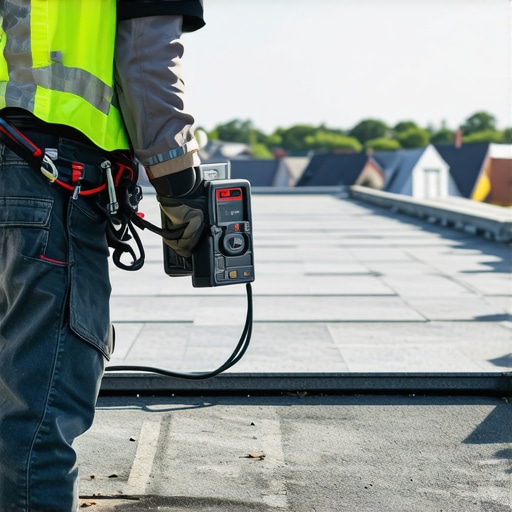
Walking on a high-end TPO roof in the blistering heat of a Nevada summer feels like walking on a drum skin. To the untrained eye of most local roofers, the membrane looks pristine—white, reflective, and seemingly intact. But the owner of this particular warehouse was watching thousands of dollars in electronics get ruined every time a monsoon rolled through. I knew exactly what I would find when I stepped onto that deck. It didn’t feel like a solid substrate; it felt like walking on a sponge disguised by a plastic sheet. I didn’t need a bucket of soapy water or a garden hose. I pulled out the ultrasonic rig. While the ‘trunk slammers’ were busy looking for visible punctures, I was listening for the scream of air turbulence through a pinhole no wider than a needle. That is the reality of roofing in 2026. If your contractor isn’t using acoustics, they’re just guessing with your money.
“Water is the most versatile solvent in nature; it will eventually find a path through any defect, no matter how microscopic, if the pressure differential exists.” – Modern Forensic Architecture Principles
The Physics of the Pinhole: Mechanism Zooming
To understand why ultrasonic testing is the gold standard for modern roofing companies, you have to understand the ‘physics of the scream.’ When a roof deck has a breach, even one as small as a shiner (a missed nail) or a hairline fishmouth in a heat-welded seam, there is often a pressure differential between the hot attic space and the cooling exterior. As air or moisture is forced through that microscopic orifice, it creates turbulence. This turbulence generates high-frequency sound waves in the 20kHz to 100kHz range—way beyond what our ears can pick up. In the Southwest, where the 140°F surface temperature causes massive thermal expansion during the day followed by rapid contraction at night, these micro-fissures open and close like breathing pores. An ultrasonic transducer converts these sound signatures into an audible signal for the technician, allowing us to pinpoint a leak within a fraction of an inch without ever tearing up a single square of material prematurely. It’s the difference between exploratory surgery and a precise MRI.
Thermal Shock and the Southwest Struggle
In regions like Phoenix or Las Vegas, the enemy isn’t just rain; it’s the sun. UV radiation bakes the plasticizers out of membranes, making them brittle. When you combine that with the thermal shock of a sudden desert downpour, the roof undergoes a violent physical transformation. Standard local roofers often miss the capillary action occurring at the cricket or the valley because the water isn’t falling straight down—it’s being pulled sideways under the membrane by a vacuum effect. Ultrasonic testing allows us to track these moisture pathways through the polyiso insulation boards. We can actually hear the ‘squish’ of saturated boards before the plywood turns to rotted mush. If you wait until you see a brown spot on your ceiling, you’ve already lost the battle against rot.
“A roof system’s primary failure point is rarely the field of the roof, but the transitions where geometry changes and physics takes over.” – NRCA Technical Manual Extract
The Band-Aid vs. The Surgery
Most roofing companies will try to sell you a ‘caulk-and-walk’ repair. They see a suspect seam, smear some goop on it, and send you a bill. But in 2026, savvy owners are demanding forensic proof. Using ultrasonic detection, we can prove whether a repair actually sealed the vacuum. We look for the absence of sound. If the ‘hiss’ of the leak remains, the patch is just a cosmetic bandage on a deep wound. We’re talking about secondary water resistance and ensuring the structural integrity of the decking remains intact. When you have a square of roofing that costs upwards of five hundred dollars, you don’t want to replace it unless the acoustics confirm the substrate is compromised. This technology stops the ‘rip and replace’ culture that has plagued the industry for decades.
Why Most Contractors Avoid This Tech
It’s simple: it makes them accountable. It’s much easier to tell a homeowner they need a whole new roof than it is to spend two hours precisely locating a four-millimeter hole. This is the ‘forensic’ side of the trade that separates the professionals from the guys with a ladder and a dream. We’re looking for thermal bridging and air bypasses that degrade your R-value. When we find a leak using ultrasound, we aren’t just looking at the surface; we are analyzing the entire assembly from the joists to the cap sheet. It requires patience, a deep understanding of acoustics, and the willingness to tell a client the truth—even if that truth means they don’t need a full replacement yet. Protecting your investment means hiring someone who values data over a quick commission.