
The Anatomy of a Slow Death: Why Your Flashing is Failing
I’ve spent twenty-five years staring at roof decks, and if there is one thing I have learned, it is that water is a microscopic locksmith. It doesn’t need a door; it just needs a microscopic flaw. My old foreman used to say, ‘Water is patient. It will wait for you to make a mistake.’ And boy, was he right. Standing on a steep-slope asphalt roof in the humid heat of the coast, you can almost hear the metal screaming. We are entering 2026, and we are seeing a massive surge in flashing failures. It is not just age; it is the physics of materials that were rushed into production years ago finally hitting their breaking point. When local roofers talk about ‘corrosion,’ most homeowners think of a little brown rust. But in the forensic world of roofing, corrosion is a systemic cancer that eats the structural integrity of your home from the outside in.
“A roof is only as good as its flashing.” – Old Roofer’s Adage
The Forensic Scene: When the Ceiling Starts Talking
It usually starts with a shadow. Not a leak, not a drip, just a faint, tea-colored discoloration in the corner of the guest bedroom ceiling. By the time that stain appears, the battle has been lost for months. When I get up there with a pry bar, the smell hits me first—the sharp, metallic scent of wet rust mixed with the earthy funk of rotting OSB. The flashing, that thin strip of metal meant to bridge the gap between roof planes and vertical walls, has become a sieve. In this climate, especially with the salt-heavy air and relentless humidity, the electrochemical reaction known as galvanic corrosion is a silent killer. We are seeing it more and more with roofing companies that took shortcuts, mixing dissimilar metals like copper and aluminum without a buffer. It is basic chemistry: when two different metals touch in the presence of an electrolyte—like rainwater—one of them starts giving up its electrons. It literally dissolves into thin air.
Sign 1: The ‘Orange Weep’ and Micro-Pitting
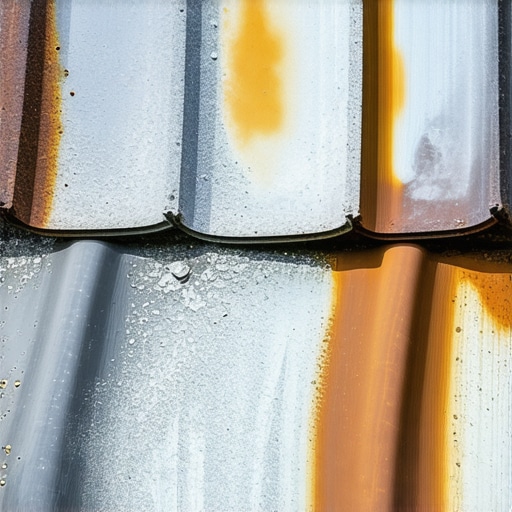
The first sign of 2026 flashing corrosion isn’t a hole; it’s a stain. Look at the base of your chimney or along the aprons. If you see ‘orange weep’—streaks of rust-colored water running down the shingles—you have a crisis in the making. This is the result of micro-pitting. In the manufacturing of galvanized steel, a thin layer of zinc is applied to protect the steel core. Over time, particularly in high-sulfur or high-salt environments, that zinc layer sacrifices itself. Once the zinc is gone, the raw steel underneath is exposed to the elements. The ‘orange weep’ is the literal blood of your roof. Local roofers who know their craft look for the loss of the spangle—that crystalline pattern on the metal. When the metal goes dull and starts shedding flakes, the ‘square’ (that’s 100 square feet in trade talk) is at risk of total saturation.
Sign 2: The ‘Puckered’ Sealant and the False Security of Caulk
I have a personal vendetta against roofing companies that think a tube of architectural grade sealant is a substitute for proper step flashing. In 2026, we are seeing the catastrophic failure of these ‘caulk-heavy’ installs. As the metal expands and contracts under the brutal 140-degree attic heat, the sealant loses its elasticity. It begins to ‘pucker’ and pull away from the masonry or the siding. This creates a tiny gap—no wider than a human hair—but through capillary action, that gap becomes a vacuum. Water is literally sucked upward, defying gravity, and pulled behind the flashing. If you see cracked, brittle, or peeling goop around your dormers, you don’t have a seal; you have a reservoir. A real roofer knows that flashing should be mechanically integrated, tucked into a ‘reglet’ or under a ‘cricket’ to divert water, not glued in place.
Sign 3: Dissimilar Metal Reaction (The Silent Battery)
This is where the forensics get interesting. Many modern roofing systems use aluminum for their valley liners but might have copper used for decorative accents or older plumbing stacks. If a contractor used galvanized nails (the ‘shiners’ we often find missing the joist) to secure copper flashing, you’ve essentially built a giant battery on your roof. The more noble metal will eat the less noble metal. By 2026, the ‘sacrificial anode’ effect has run its course. I’ve seen copper valley flashing that looked beautiful on the surface, but underneath, the steel fasteners had completely disintegrated, leaving the flashing held in place by nothing but habit and gravity. When the wind picks up, those sheets start to chatter, and eventually, they depart the roof entirely.
“The primary purpose of flashing is to provide a weather-resistant barrier that prevents water from entering the building envelope at joints and intersections.” – NRCA Manual
Sign 4: The Failure of the ‘Kickout’ and Saturated Fascia
If you want to find the most common failure point, look where the roof edge meets a vertical wall. Without a ‘kickout’ flashing—a small piece of metal bent at an angle to direct water away from the wall and into the gutter—the water simply follows the wall down. In 2026, we are seeing the long-term effects of missing kickouts in the form of rotted fascia boards and moldy wall sheathing. The water gets behind the siding and stays there, never drying out. I recently inspected a home where the homeowner thought they just needed a small repair. I put my hand against the siding and it felt like a sponge. The flashing had corroded at the corner, and for three years, every rainstorm had been dumping gallons of water directly into the wall cavity. This isn’t just a roofing problem; it’s a structural nightmare.
Sign 5: Solder Fatigue in Custom Valleys
For high-end homes with custom metal work, the solder joints are the Achilles’ heel. Solder is a softer alloy, and it doesn’t handle thermal expansion as well as the parent metal. Over decades of the sun beating down and the nights cooling off, these joints develop stress fractures. In 2026, many of the ‘custom’ roofs installed a decade or two ago are reaching their fatigue limit. These cracks are often invisible to the naked eye until you apply a little pressure. If your local roofers aren’t checking the integrity of the soldered seams in your valleys or around your skylights, they aren’t doing a forensic inspection. They’re just guessing.
The Band-Aid vs. The Surgery
When you find these signs, you have two choices. The ‘Band-Aid’ involves more caulk and some silver paint to hide the rust. It might buy you six months, but it’s a coward’s fix. The ‘Surgery’ is what we do: we tear back the shingles, remove the compromised metal, and install new, heavy-gauge flashing with proper counter-flashing techniques. We ensure there’s a ‘cricket’ behind every chimney to prevent water from pooling. We don’t just stop the leak; we change the physics of the roof so the leak can’t happen. Don’t let a ‘trunk slammer’ tell you a little bit of roofing cement will fix a corroded valley. It’s like putting a piece of tape over a gunshot wound. You need to address the underlying metal failure before the plywood turns to oatmeal and you’re looking at a five-figure restoration bill.