
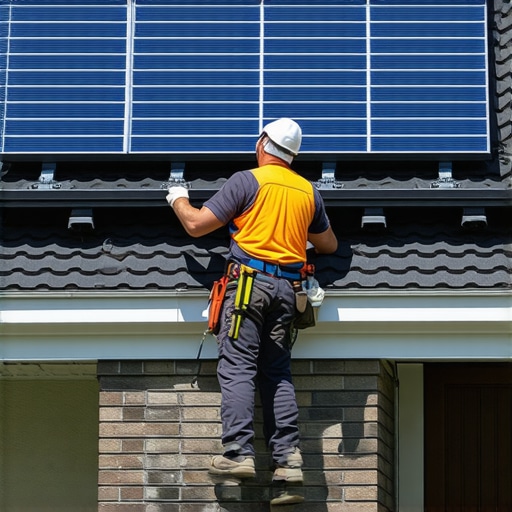
The Forensic Autopsy of a Modern Rooftop Failure
The first thing you notice isn’t the water stain on the drywall; it’s the smell. In the 130-degree furnace of a desert attic in mid-August, moisture doesn’t just sit. It brews. It creates a humid, earthy rot that tells a forensic roofer everything he needs to know before he even climbs the ladder. I’ve spent twenty-five years watching roofing companies rush through installations, and the new 2026 solar brackets are becoming the next great nightmare for homeowners. These aren’t just pieces of hardware; they are potential entry points for catastrophe if your local roofers don’t understand the physics of a thermal bridge.
“A roof is only as good as its flashing, and solar mounts are simply a thousand new opportunities for a flashing failure.” – Old Roofer’s Adage
The Physics of Failure: Why Your Brackets Are Leaking
To understand why these high-tech 2026 brackets fail, we have to look at Mechanism Zooming—the microscopic reality of what happens when metal meets asphalt under the relentless Southwest sun. Most roofing companies treat a solar mount like a simple bolt-down operation. It isn’t. In the desert, we deal with thermal shock. During the day, that aluminum bracket reaches temperatures that would sear your palms. It expands. The asphalt shingle beneath it softens, becoming almost viscous. Then, the sun drops, the desert air chills, and the metal shrinks. This constant expansion and contraction creates a ‘pumping’ action. If the lag bolt isn’t centered perfectly in the rafter—what we call a shiner—that movement eventually wallows out the hole in the plywood decking.
Once that hole is wallowed out, capillary action takes over. Water doesn’t just fall into a hole; it is pulled. During a monsoon downpour, the surface tension of the water allows it to crawl horizontally across the underside of the shingle, searching for that compromised seal. If your local roofers used a standard ‘puck’ mount without a secondary water resistance layer, that water is going straight into your insulation. My old foreman used to say, ‘Water is patient. It will wait for you to make a mistake.’ He was right. It doesn’t need a flood; it just needs a microscopic path and the patience of a saint.
The 2026 Compression Seal: A False Sense of Security?
The 2026 bracket designs often boast ‘compression-fit’ technology, claiming they don’t need traditional metal flashing. They rely on high-grade butyl tapes and EPDM gaskets. On paper, it’s genius. In the real world, where local roofers are installing five squares of solar-ready roofing a day in 110-degree heat, it’s a gamble. If the roof deck is dusty—which it always is—the butyl tape bonds to the dust, not the shingle. You’ve now created a ‘bridge’ for water to bypass the gasket. When I inspect these, I’m looking for the ‘squish’ factor. If I don’t see a uniform bead of sealant squeezed out from the edges of the bracket, I know it was torqued down on an uneven surface or a ‘high nail’ from the original roof installation.
“Roofing assemblies shall be designed and installed in accordance with this code and the manufacturer’s installation instructions.” – IRC Building Code Section R903.1
The Forensic Checklist for Local Roofers
When you hire roofing companies to inspect these systems, you need to demand they check the structural integrity of the lag. I’ve seen ‘trunk slammers’ miss the rafter entirely, hitting only the 1/2-inch OSB. They might feel the bolt ‘snug up,’ but it has zero structural pull-out resistance. Under a wind load, that solar panel acts like a sail, tugging on the bracket. That tugging breaks the chemical bond of the sealant. The Forensic Scene: Walking on that roof felt like walking on a sponge. I knew exactly what I’d find underneath. I pulled a single bracket and found the plywood had the consistency of wet cardboard because the installer had missed the rafter by half an inch, creating a permanent funnel for every rainstorm for three years.
The Solution: Surgery vs. Band-Aids
If you find a leak, don’t let a contractor tell you a tube of caulk will fix it. That is a Band-Aid for a problem that requires surgery. The correct fix involves removing the bracket, checking the decking for dry rot, and reinstalling a flashed system that redirects water around the penetration rather than relying on a chemical seal to stop it. We use crickets to divert water around large obstructions, but for a solar bracket, your best defense is a tiered flashing system. Look for local roofers who understand the ‘3-Course’ method of sealing or those who utilize integrated flashing plates that slide under the course of shingles above the mount.
How to Vet Your Local Roofing Companies
Don’t ask about their warranty; ask about their flashing detail. A ‘Lifetime Warranty’ is marketing nonsense that disappears the moment the company changes its LLC name. Ask them how they handle thermal expansion in the rails. Ask them what they do when they hit a ‘shiner.’ If they don’t know the term, they haven’t spent enough time on a hot roof. You want a veteran who has seen the ‘oatmeal plywood’ and has the scars to prove they learned from it. In the world of 2026 solar technology, the brackets may be new, but the physics of water is ancient. Don’t let your roof be the laboratory for a rookie’s mistake.