
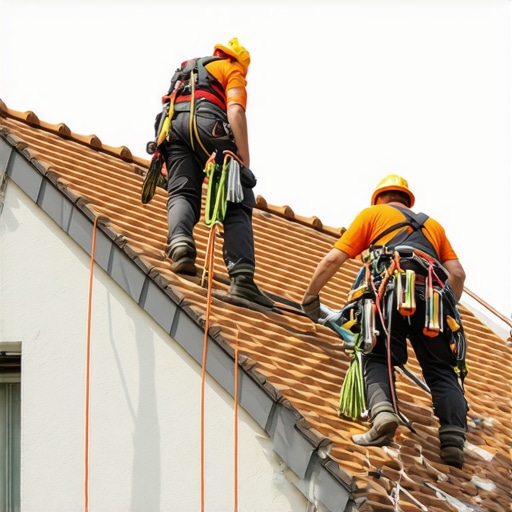
The drip-drip-drip on the kitchen island isn’t the problem. It’s the symptom of a war you’ve already lost three stories up. When you’re dealing with a 10/12 or 12/12 pitch—slopes so aggressive you can’t stand on them without a harness and a prayer—the physics of water management changes entirely. Most roofing companies approach a leak with a bucket of mastic and a ‘hope for the best’ attitude, but by 2026, the forensic reality of steep-slope roofing has left those ‘trunk slammers’ in the dust. If your roofer isn’t talking about hydrostatic pressure and capillary action, they aren’t fixing your roof; they’re just decorating it.
Back in the late 90s, my old crew lead, a man who had more tar on his boots than sense in his head, used to grunt: ‘Son, gravity is a lazy contractor. On a steep slope, it’ll take the first shortcut it finds, and that shortcut usually leads straight to a homeowner’s drywall.’ He was right. On a steep pitch, water doesn’t just fall; it accelerates. It gains kinetic energy that flat-roof installers never have to worry about. By the time that water hits a valley or a chimney base, it’s a high-velocity stream looking for any imperfection in the flashing. If there’s a single shiner—a nail that missed the rafter and left a cold metal shank exposed—that water will find it, cling to it via surface tension, and follow it straight through your plywood and into your attic insulation.
The Physics of Failure: Why Steep Slopes Leak Differently
In our northern climate, steep pitches are designed to shed snow, but they create a unique nightmare: the concentrated ice dam. You might think a 45-degree angle would keep ice from forming, but that’s where you’re wrong. Heat rising from an under-insulated attic hits the peak, melts the bottom layer of snow, and sends it racing down the shingles. As soon as it hits the cold eaves, it flash-freezes. On a steep slope, this happens with more force, backing up water under the starter strip with terrifying speed. [IMAGE_PLACEHOLDER] This is where the 2026 standard of ‘Ice and Water Shield’ separates the pros from the amateurs. We aren’t just putting a three-foot strip at the bottom anymore. In a high-pitch forensic repair, we’re looking for thermal bridging where the roof meets the wall, ensuring the secondary water resistance is integrated into the drainage plane.
“A roof is only as good as its flashing.” – Old Roofer’s Adage
Let’s talk about the ‘Shiner.’ If you’ve ever looked in your attic and seen a nail that looks like it’s weeping, that’s a shiner. In steep-slope applications, roofers are often working at awkward angles. They miss the ‘sweet spot’ on the shingle—the narrow band where the common bond is strongest. When they miss the wood, that nail becomes a thermal bridge. In the dead of a Chicago winter, that cold nail head condenses the warm, moist air from your house into water droplets. It looks like a roof leak, but it’s actually a ventilation and fastening failure. By 2026, top-tier roofing companies are using infrared drones to spot these thermal signatures before they ever tear off a single square of shingles.
The Anatomy of a 12/12 Pitch Repair
When we perform a ‘Forensic Autopsy’ on a steep roof, we start at the valley. Valleys are the highways of your roof. On a steep pitch, the volume of water channeled into these intersections is immense. Traditional ‘woven’ valleys—where shingles overlap like a basket weave—are a recipe for disaster in 2026. The grit from the shingles washes down and settles in the woven folds, creating tiny dams that hold moisture against the asphalt. Instead, we use open metal valleys with a ‘W-diverter.’ This is a piece of heavy-gauge metal with a ridge in the middle that prevents water from one side of the roof from rushing across and underneath the shingles on the other side.
“The building envelope must be viewed as a continuous system, not a collection of parts.” – Modern Building Science Axiom
Then there’s the cricket. If you have a chimney wider than 30 inches on a steep roof, and you don’t have a cricket, your roof is a ticking time bomb. A cricket is a small, peaked structure built behind the chimney to divert water to the sides. Without it, the chimney acts as a dam, collecting leaves, pine needles, and snow. That debris holds water like a sponge, eventually rotting out the sub-fascia and the chimney framing itself. I’ve seen chimneys in the suburbs where the plywood was so rotted you could put a finger through it, all because a local roofer was too lazy to frame in a simple water diverter.
The 2026 Technology Leap: Augmented Reality and Synthetic Defense
The days of ‘felt paper’ are over. If your contractor is still using black organic felt, fire them. In 2026, we use high-tenacity synthetic underlayments that are practically untearable. On a steep slope, this is a safety issue as much as a waterproofing one. These synthetics have a non-slip surface that allows local roofers to move with more confidence. Furthermore, we’re seeing the rise of AR (Augmented Reality) on the job site. Foremen can now wear glasses that overlay the original structural blueprints onto the existing roof deck, highlighting exactly where the load-bearing walls are and where the ventilation baffles should be placed for maximum ‘stack effect’ cooling.
Speaking of ventilation, steep roofs create massive attic volumes. Standard ridge vents often aren’t enough. You need a balanced system of soffit intake and exhaust that accounts for the increased vertical height of the attic space. Without this, the heat builds up to 150°F, ‘baking’ the shingles from the inside out and shortening a 30-year roof to a 15-year roof. The warranty won’t cover it because it’s a ‘system failure,’ not a ‘material failure.’ That ‘Lifetime Warranty’ the salesman promised you? Read the fine print. It usually only covers the material, not the labor to fix the rotten deck caused by poor airflow.
How to Pick a Roofer Who Won’t Disappear
When you’re vetting roofing companies, ask about their steep-slope safety and fastening patterns. A ‘square’ of shingles on a 4/12 pitch requires four nails. That same square on a 12/12 pitch needs six, and they must be placed precisely. Ask to see their ‘starter strip’ protocol. On high-pitch roofs, wind uplift is a major threat; the wind hits the wall, travels up, and catches the bottom edge of the shingles. If the starter strip isn’t set perfectly, the whole roof can peel off like an orange skin in a thunderstorm.
Don’t settle for a Band-Aid. A smear of caulk around a pipe boot is a six-month fix. A forensic repair involves pulling the shingles back to the deck, inspecting for ‘oatmeal’ plywood—wood so water-logged it has lost its structural integrity—and replacing the flashing with kynar-coated steel or copper. It’s more expensive up front, but it’s cheaper than replacing your dining room ceiling every three years. Remember, water is patient. It’s waiting for that one missed nail, that one un-taped seam, that one shortcut. Don’t give it the satisfaction.