
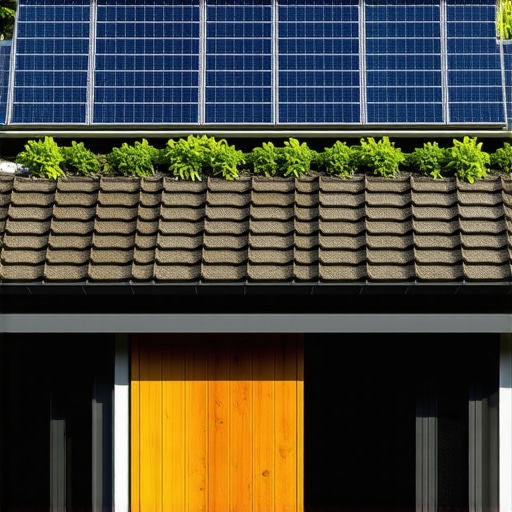
The Architect’s Dream and the Roofer’s Nightmare
My old foreman, a man whose knees sounded like a bucket of gravel every time he stood up, used to lean on his hammer and tell me: ‘Water is patient. It will wait for you to make a mistake, and then it will move in and start a family.’ After twenty-five years of pulling up rotted decking and chasing leaks that shouldn’t exist, I’ve realized he was an optimist. Water doesn’t just wait; it hunts. Especially when we start talking about the 2026 trend of ‘Modern Sheds.’ These aren’t just places to throw a rusty lawnmower anymore. We’re talking $100,000 backyard offices, yoga studios, and ‘dwellings’ that are packed with sensitive electronics. When people ask about eco-friendly roofing for these structures, they usually want something that looks like a Pinterest board. I want something that won’t turn the wall studs into compost by 2030.
“A roof is only as good as its flashing.” – Old Roofer’s Adage
The Physics of the Modern Shed Slope
Most modern sheds utilize a mono-pitch or ‘lean-to’ design with a low slope. This is where local roofers get into trouble. They treat a 2:12 pitch like it’s a standard residential gable. It’s not. On a low-slope eco-roof, water doesn’t run; it lingers. It uses capillary action to defy gravity, pulling itself upward under the laps of your fancy sustainable shingles. If you don’t have a secondary water resistance layer that’s been heat-welded or properly taped, you aren’t building a roof; you’re building a slow-release sponge. Let’s look at the five solutions that actually hold up under forensic scrutiny.
1. Modular Green Roofs (The Sedum Strategy)
Everyone loves the idea of a living roof. It’s the ultimate eco-statement. But here’s the trade truth: dirt is heavy, and wet dirt is a structural liability. To do a green roof on a modern shed in 2026, you shouldn’t be dumping soil on a membrane. You need modular trays. The mechanism of failure in most green roofs is the ‘clogged artery’ effect. Fine particulates from the growth medium migrate downward and choke the drainage layer. Once that happens, hydrostatic pressure builds up against the waterproofing membrane. I’ve seen 60-mil TPO membranes fail because the water sat so long it found a shiner—a missed nail—from the original construction and siphoned through the shank. For a shed, stick to sedum mats with a cricket installed behind any chimney or skylight to ensure water doesn’t pool.
2. Recycled Polymer Composite Shingles
These are made from post-consumer plastic and rubber, often reclaimed tires or milk jugs. They look like slate or cedar, but they don’t rot. However, they suffer from thermal expansion. In a single day, a roof can swing from 60°F at dawn to 140°F in the direct sun. If the roofing companies you hire don’t understand the ‘slot-and-tab’ spacing requirements, these shingles will buckle. When they buckle, they lift the starter strip, creating a valley where wind-driven rain can get forced underneath. It’s not a ‘product failure’; it’s a physics failure. You want a composite with a high UV-inhibitor rating, or the sun will literally bake the flexibility out of the plastic within a decade.
3. Standing Seam Metal with ‘Cool’ Coatings
If you want longevity, metal is the king, but it has to be done right. For 2026, we’re seeing ‘cool roof’ pigments that reflect infrared radiation. But watch out for the fasteners. I’ve seen ‘eco-friendly’ metal roofs held down by exposed screws with rubber washers. In five years, that rubber gets brittle, cracks, and you have 500 tiny leaks. A true standing seam uses hidden clips. This allows the metal to slide as it expands and contracts. If you pin it down tight, it will ‘oil can’—that’s the trade term for when the metal ripples and pops like an old soda can. That popping sound isn’t just annoying; it’s the sound of your fasteners fatiguing.
“Roofing systems shall be designed and installed in accordance with this code and the approved manufacturer’s instructions.” – International Residential Code (IRC) R905.1
4. Building-Integrated Photovoltaics (BIPV)
Solar shingles are the ‘holy grail’ for modern sheds. But here’s the forensic reality: heat is the enemy of electricity. When you integrate solar directly into the roof surface without an air gap, the cells get incredibly hot. This reduces efficiency and accelerates the degradation of the underlying ice and water shield. If one cell fails, are you replacing a shingle or the whole square? You need a system with ‘bypass diodes’ so one shady leaf doesn’t kill the whole string. And for the love of the craft, make sure the local roofers aren’t also trying to be amateur electricians. The penetrations for the wiring are where 100% of these roofs eventually fail.
5. Upcycled Terracotta and High-Mass Tile
In warmer climates, high-mass materials like clay are actually quite eco-friendly because of their thermal lag. They keep the shed cool well into the afternoon. The ‘trap’ here is the batten system. If the tiles are laid directly on the deck, debris gets trapped underneath, holds moisture, and rots the fascia boards. You need a ‘counter-batten’ system that allows air to flow from the eave to the ridge. It’s about ventilation. A roof that can’t breathe is a roof that’s dying from the inside out. I’ve walked on tile roofs that felt like a sponge because the thermal bridging caused so much condensation in the attic space that the plywood turned to ‘oatmeal.’
The Final Walk-Through: Don’t Buy the Marketing
When roofing companies start throwing around ‘Lifetime Warranties’ on these new eco-materials, read the fine print. Most of those warranties only cover ‘manufacture defects,’ not ‘improper installation’ or ‘weather events.’ If your roofer doesn’t know what a drip edge is or fails to install a cricket where the roof meets a vertical wall, that warranty is just a piece of paper. You don’t need a salesman; you need a mechanic who understands how water moves. Modern sheds are beautiful, but physics doesn’t care about aesthetics. Choose a material that matches your climate’s specific ‘Enemy’—be it UV, ice, or humidity—and ensure every valley and penetration is flashed like it’s going to be underwater. Because eventually, it will be.