
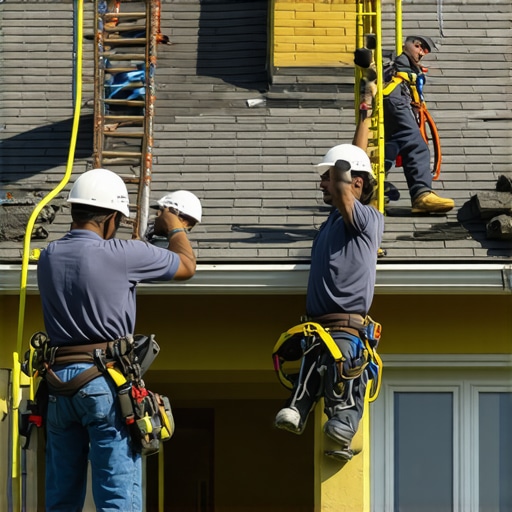
The Autopsy of a ‘Sound’ Roof: Why 2026 is the Year of Reckoning
Walking on that roof felt like walking on a sponge. I knew exactly what I would find underneath before I even pulled my flat bar out of my belt. The homeowner told me the shingles were ‘only twelve years old,’ but the bounce in the deck told a different story. When we finally peeled back the layers, the OSB was black, slick with a fungal mat that smelled like a swamp in mid-August. This was not a product failure; it was a systemic failure of physics. As local roofers, we see this every day—homeowners who think they are safe because they don’t see a drip in the kitchen yet. But by the time the water hits your coffee table, the forensic evidence of neglect has been mounting for years.
The Physics of the Leak: Beyond the Surface
To understand roof maintenance safety in 2026, you have to stop thinking about shingles as a waterproof blanket. They are a water-shedding system, and there is a massive difference. Water is a patient, relentless adversary. It uses capillary action to climb uphill. If your roofing companies didn’t install a proper starter course or if they skimped on the offset, water will find the gaps and pull itself upward, under the shingle, and straight to the nail heads. Once it hits a nail—especially a shiner that missed the rafter—you have a direct conduit for moisture to bypass your decking and rot your structural integrity from the inside out.
“Roofing systems shall be designed and installed in accordance with this code and the manufacturer’s installation instructions.” – International Residential Code (IRC), Section R903.1
The 2026 standards for safety focus heavily on the ‘thermal bypass.’ In colder climates, we are seeing more damage from the inside than the outside. Warm, moist air from your bathroom or kitchen escapes into the attic because of poor air sealing. This air hits the cold underside of the roof deck, condenses, and rains back down onto your insulation. You call local roofers thinking you have a leak, but what you actually have is a respiratory problem in your house. The deck stays wet, the wood loses its ‘bite’ on the nails, and the next wind storm peels your roof back like a banana skin.
Tip 1: The Forensic Perimeter Inspection
Safety starts at the edge. Most roofing companies ignore the drip edge, or worse, they install it over the underlayment instead of under it at the eaves. In 2026, we are looking for Secondary Water Resistance (SWR). You need to ensure your ice and water shield is fused to the deck and extends at least 24 inches inside the interior wall line. If you are standing on a ladder looking at your gutters, look for ‘granule silt.’ If your gutters look like a beach, your asphalt shingles are losing their UV protection. Without those granules, the sun cooks the asphalt, the shingle shrinks, and the ‘keyways’ open up. That is when the real trouble starts.
Tip 2: Managing the ‘Cricket’ and Chimney Flashing
If you have a chimney wider than 30 inches and no cricket, you are living on borrowed time. A cricket is a small peaked structure behind the chimney designed to divert water. Without it, the chimney acts as a dam. Water pools, hydrostatic pressure builds, and eventually, it forces its way through the flashing.
“A roof is only as good as its flashing.” – Old Roofer’s Adage
We use forensic tools now—infrared cameras that can detect the temperature differential of wet insulation behind a wall. If your local roofers aren’t checking the counter-flashing for sealant fatigue, they aren’t doing their job. Caulk is a temporary fix; a mechanical lock is the only way to ensure 20-year safety.
Tip 3: The ‘Shiner’ and Fastener Fatigue
A ‘shiner’ is a nail that missed the framing and is sticking out in the attic. In the winter, these nails get frosted over. When the sun hits the roof, they thaw and drip. Over a decade, that’s thousands of gallons of water hitting your ceiling. When interviewing roofing companies, ask them about their nailing pattern. Are they using four nails or six? In high-wind zones, four nails is professional negligence. If those nails aren’t driven flush—if they are ‘high-nailed’—the shingle won’t seal properly. If the shingle doesn’t seal, the wind will catch it, and you’ll have a square of shingles in your neighbor’s yard.
Tip 4: Ventilation and the 1/300 Rule
Modern roofing is an exercise in airflow. You need one square foot of ventilation for every 300 square feet of attic floor space. But it has to be balanced. If you have too much exhaust and not enough intake (soffit vents), the ridge vent will actually suck air—and rain or snow—into the attic. This is a common mistake by local roofers who don’t understand the ‘Bernoulli Principle.’ A safe roof in 2026 must breathe. If your attic is 140 degrees in July, your shingles are being baked from both sides. This causes ‘thermal shock,’ where the rapid cooling during a summer rain causes the shingles to crack and lose their structural bond.
Tip 5: Identifying the ‘Trunk Slammer’ Trap
Safety isn’t just about the materials; it’s about the warranty. Most ‘Lifetime Warranties’ are marketing fluff. They cover the material, but not the labor to fix the mistake. If a contractor offers you a price that’s 30% lower than everyone else, they are cutting corners on the starter strip, the hip and ridge, or the underlayment. They might use ‘felt paper’ instead of a modern synthetic. Synthetic underlayment is nearly impossible to tear, providing a critical secondary layer of protection if the shingles fail. Don’t be fooled by a low bid that ignores the ‘valleys.’ A valley should be lined with a heavy-gauge metal or a specialized ice and water shield, not just overlapped shingles which will bridge and crack over time.
Conclusion: The Cost of the ‘Wait and See’ Approach
Roofing is the most dangerous trade for a reason—not just for the guys on the rafters, but for the homeowners who ignore the warning signs. A small leak doesn’t stay small; it’s a cancer. By the time 2026 rolls around, the materials we used twenty years ago will be reaching their failure point. Don’t wait for the ‘oatmeal plywood’ scenario. Get a forensic inspection, check your ventilation, and ensure your local roofers are using trade-grade fasteners and flashing techniques. Your roof is the only thing between your family and the elements; treat it like the engineering marvel it is supposed to be.
This article really highlights the importance of proactive roof maintenance, especially with the changing standards aimed at 2026. I agree that many homeowners overlook the critical details like drip edge alignment and proper underlayment, which can make all the difference. Personally, I had a roof inspection last year after noticing some granule loss, and it turned out I had some shiners causing potential leaks. It makes me wonder how many small issues go unnoticed until they result in significant damage. I’m particularly interested in the use of infrared cameras for detecting moisture behind walls — anyone here have experience with that technology? It seems like a game-changer for early detection. Overall, I think investing in regular forensic inspections and understanding the technical aspects, like the proper nailing pattern and ventilation ratios, is essential for longevity and safety. What other preventive measures have others found effective that weren’t covered here?