
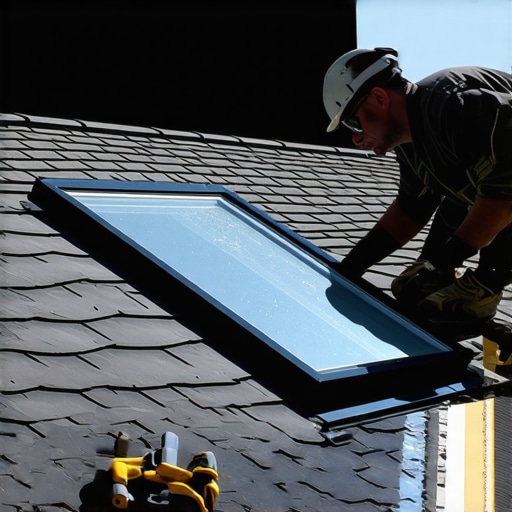
The Midnight Drip: Why Your Skylight is a Ticking Time Bomb
There is a specific sound that keeps homeowners awake at 2 AM in the middle of a November sleet storm. It is not the wind rattling the gutters or the house settling; it is the rhythmic, metallic tink-tink-tink of water hitting the kitchen island. By the time you see that brown ring forming on the drywall surrounding your skylight, the war is already half-lost. As a forensic roofer who has spent three decades crawling through cramped, 140-degree attics and peeling back layers of rotten cedar, I can tell you one thing for certain: a skylight is essentially a hole in your umbrella that you’ve paid someone to plug. If that plug isn’t maintained, physics will eventually win.
My old foreman, a man we called ‘Iron Lung’ Pete because he could work twelve hours on a 12-pitch roof without breaking a sweat, used to tell me every morning: ‘Water is patient. It doesn’t have a job, it doesn’t have a family, and it doesn’t get tired. It will wait years for you to make a 1/16th-inch mistake, and then it will invite itself in.’ Pete was right. In our climate, where the freeze-thaw cycle acts like a hydraulic jack every winter, skylight seals aren’t just features; they are active combat zones. As we look toward the 2026 maintenance cycle, you need to stop thinking about your skylight as a ‘window in the roof’ and start thinking about it as a complex flashing system that is currently under siege by UV radiation and thermal expansion.
The Physics of Failure: Why Skylights Leak
Most people think a leak happens because there is a ‘hole’ in the roof. In reality, it’s usually about capillary action. Imagine two surfaces pressed tightly together—like a shingle and a piece of metal flashing. Water can actually ‘climb’ upward between those surfaces if the tension is right. When local roofers tell you they can just ‘caulk it,’ they are lying to you or they don’t understand the trade. Caulk is a temporary sealant that loses its elasticity after a few seasons of baking in the sun and freezing in the snow. When the caulk cracks, it creates a microscopic reservoir that sucks water in via hydrostatic pressure. Once that water gets behind the metal, it hits your plywood deck. Since the deck is often covered in non-breathable underlayment, the water has nowhere to go but down, soaking into the wood until it turns into something resembling wet oatmeal.
“The assembly of the roof shall be designed and installed in accordance with this code and the manufacturer’s installation instructions such that it provides a weather-resistant exterior wall envelope.” – International Residential Code (IRC), Section R703
If you are hiring roofing companies to look at your skylights in 2026, you cannot afford to be passive. You need to grill them like a detective at a crime scene. Here are the five questions that will separate the true craftsmen from the ‘trunk-slammers’ who will be out of business by the time your ceiling starts dripping again.
1. Are we talking about a ‘Band-Aid’ or ‘Surgery’?
If a roofer climbs up there and says they can fix the leak with a tube of plastic roof cement (we call it ‘muck’ in the trade), kick them off your property. A ‘Band-Aid’ fix is smear-and-hope. ‘Surgery’ means removing the surrounding shingles, pulling the old flashing, inspecting the curb for rot, and installing a new 4-inch perimeter of ice and water shield. If they aren’t prepared to tear back to the wood, they aren’t fixing the leak; they’re just hiding it for the next guy to find.
2. How will you handle the ‘Thermal Bridge’ and Condensation?
In cold climates, many ‘leaks’ aren’t actually rain getting in—they are warm air getting out. This is thermal bridging. If the skylight frame isn’t properly insulated against the roof rafters, the warm, moist air from your bathroom or kitchen hits the cold aluminum frame and turns into liquid. This water then runs down the inside of the drywall, mimicking a roof leak. Ask your roofing professional how they plan to seal the air-gap between the skylight curb and the rough opening. If they don’t mention spray foam or specialized backer rod, they don’t understand the forensic side of the job.
3. Curb-Mount or Deck-Mount: Which Flashing Kit are you Using?
This is where many local roofers get lazy. A curb-mount skylight sits on a wooden box (the curb), while a deck-mount sits flush. Each requires a specific flashing sequence. If you have a deck-mount, the step flashing must be woven into every single course of shingles. I’ve seen hundreds of ‘shiners’—missed nails—driven straight through the flashing by installers who were moving too fast. Those shiners act like little straws, drawing water directly into your attic. Demand to see the manufacturer’s specific flashing kit for the 2026 model year.
4. What is the state of the ‘Apron’ and the ‘Cricket’?
On larger skylights or those positioned near a valley, water can pile up behind the unit. This is called ‘damming.’ A proper installer might need to build a cricket—a small diverted roof peak—behind the skylight to split the water flow. If your roofer doesn’t even know what a cricket is, or if they plan to reuse the old, pitted aluminum apron at the bottom of the unit, they are setting you up for a catastrophic failure. Aluminum fatigues over time; by 2026, a skylight installed in 2010 has gone through enough thermal expansion cycles to make the metal as brittle as a soda can.
“Flashings are the most vulnerable part of any roofing system. A roof is only as good as its flashing, and its flashing is only as good as the technician who installed it.” – NRCA (National Roofing Contractors Association) Guidelines
5. How do you handle the Secondary Water Resistance (SWR)?
The shingles are your first line of defense, but the ice and water shield is your last. In 2026, code requirements are getting stricter. You want to ensure that the membrane is lapped over the skylight flange and under the primary underlayment. This creates a shingle-effect for the water. If they do it backward—a common mistake—the water will just slide under the membrane and rot your rafters. I once saw a $40,000 kitchen renovation ruined because a roofer lapped his felt paper over his flashing instead of under it. It took three years for the rot to show, but by then, the mold was so thick you could smell it from the driveway.
The Cost of Silence
Roofing is an invisible industry. You don’t see the mistakes until it’s too late. If you hire roofing companies based solely on the lowest bid, you are essentially gambling that they won’t cut corners on the flashing. But here’s the trade secret: the flashing is where the labor is. It’s easy to throw ‘squares’ of shingles down on a flat run. It’s hard, tedious, and back-breaking work to properly flash a skylight. You pay for the time it takes to do it right, or you pay for the damage when it’s done wrong. Don’t let your skylight become a forensic case study in 2026. Ask the hard questions now, before the tink-tink-tink starts.