
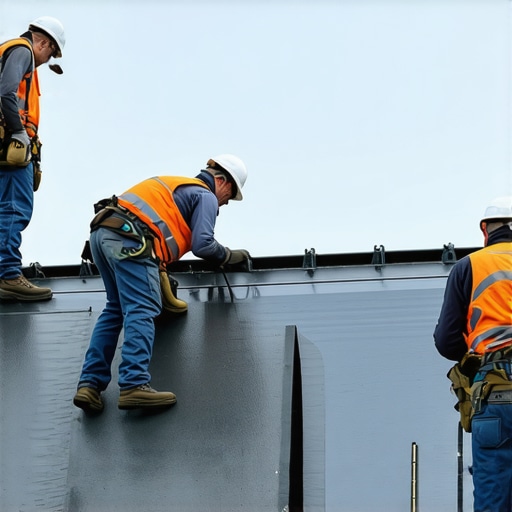
The Ghost in the Flat Roof: Why Your Seams Are Failing
I have spent the better part of three decades standing on flat roofs in the biting wind of late November, peeling back layers of membrane to find out why a million-dollar inventory is being ruined by a drip the size of a dime. My old foreman used to say, ‘Water is patient. It will wait for you to make a mistake.’ He wasn’t talking about the big holes. He was talking about the seams. In the forensic roofing world, we don’t look for the obvious; we look for the physics of failure. Most roofing companies today are still playing catch-up with the technology of 2026, but the elite local roofers have already transitioned to the new EPDM (Ethylene Propylene Diene Terpolymer) seam standards. Why? Because the old ways of ‘glue and a prayer’ are costing homeowners and building managers a fortune in hidden rot.
1. The Evolution from Splice Cement to Molecular Fusion
Back in the day, we used splice cement. It smelled like a chemical plant and had the consistency of molasses. You’d brush it on, wait for it to get tacky—not too wet, not too dry—and then marry the two sheets of rubber. The problem? Human error. If the roofer had a bad day or it was 90% humidity, that bond was destined to fail. Modern roofing involves factory-applied tape (FAT). This isn’t just sticky tape; it is a chemically engineered primer and adhesive system that creates a vulcanized bond. When we talk about 2026 EPDM seams, we are talking about a transition from a mechanical bond to a chemical one. The seam becomes the strongest part of the roof, not the weakest link. In the North, where the mercury swings 60 degrees in a single day, this is the difference between a dry attic and a structural nightmare.
“A roof is only as good as its flashing and the integrity of its primary seams.” – Old Roofer’s Adage
2. Managing the Physics of Thermal Expansion
EPDM is a dark material. On a summer day, that black rubber can hit 160°F. At night, it might drop to 60°F. That 100-degree swing causes the membrane to ‘grow’ and ‘shrink.’ If your local roofers don’t account for this thermal shock, the membrane pulls at the seams. This is where ‘Mechanism Zooming’ becomes vital. Imagine the microscopic level: as the rubber expands, it exerts shear force on the adhesive. Older adhesives would ‘creep’—they’d slowly slide, creating a tiny opening known as a ‘fish-mouth.’ Once a fish-mouth forms, capillary action takes over. Water doesn’t just fall in; it is sucked in. It travels sideways, sometimes ten feet from the actual leak, until it finds a screw hole in the insulation. By the time you see a drip, the plywood is already the consistency of wet cardboard.
3. The Death of the ‘Shiner’ and the Rise of Perimeter Security
In roofing, a ‘shiner’ is a nail that missed the joist, sticking up like a thumb. In EPDM systems, the 2026 standards have moved toward reinforced perimeter strips. Instead of just gluing the rubber to the edge, we use mechanical termination. This prevents the ‘tenting’ effect where the membrane pulls away from the wall. If you look at how roofing companies used to do it, they’d just run the rubber up the wall and go home. Now, we use heavy-duty termination bars and specialized sealants that remain flexible for 30 years. If your contractor isn’t talking about ‘compression loading’ at the termination point, they aren’t installing a 2026-grade roof.
4. Vapor Migration and the Attic Bypass
In cold climates, the enemy isn’t just rain; it is the air inside your house. Warm, moist air rises. If there is a break in the vapor barrier—an ‘attic bypass’—that moisture hits the cold underside of the EPDM membrane and turns into frost. When the sun comes out, that frost melts. You think you have a roof leak, but what you actually have is a physics problem. The 2026 EPDM systems integrate high-density polyiso insulation with a dedicated vapor retarder. This keeps the ‘dew point’ outside of the roof assembly. Local roofers who understand this ‘thermal bridging’ can save a homeowner 30% on their heating bills just by getting the seam and insulation logic right.
“The building envelope must be continuous; any interruption is an invitation for structural decay.” – Principles of Modern Architecture
5. Hydrostatic Pressure and the ‘Cricket’ Strategy
Water should never stand on a seam. Yet, I see it every day. Poorly designed flat roofs have ‘ponds.’ When water sits on a seam, it exerts hydrostatic pressure. Even a microscopic void will eventually give way. This is why 2026 roofing companies insist on ‘crickets.’ A cricket is a small, sloped structure built into the roof to divert water toward the drains or scuppers. It’s like a tiny valley on a flat surface. By moving water away from the seams, we eliminate the pressure. I’ve done autopsies on roofs where the seams were perfect, but because the roof didn’t have a cricket, the water sat there until it literally dissolved the secondary sealants.
6. The ‘Lifetime Warranty’ Trap vs. Real-World Longevity
Don’t get me started on ‘Lifetime Warranties.’ They are a marketing tool, not a performance guarantee. Most of those warranties cover ‘manufacturing defects’ but exclude ‘workmanship’—and 99% of leaks are workmanship issues. The 2026 EPDM standard focuses on the ‘Square’ (100 square feet) cost over 40 years, not 5 years. A cheap roof is a down payment on a second, more expensive roof. When you hire roofing companies, ask about their seam testing protocol. Do they use a probe to check for voids? Do they use a weighted roller? If they just slap it down and walk away, that ‘lifetime’ warranty is worth the paper it’s printed on and nothing more.
7. UV Resilience and the Black-to-White Shift
While black EPDM is the king of the North for its heat-absorption (which helps melt snow), 2026 tech has introduced highly reflective coatings that can be applied to the seams. This prevents ‘UV degradation.’ The sun’s rays are like a slow-motion fire. They bake the oils out of the rubber. The new seam tapes are designed with carbon black stabilizers that are specifically tuned to resist the increased UV levels we’ve seen over the last decade. It’s about protecting the ‘cross-linking’ of the polymers. If those polymers break down, the rubber becomes brittle and cracks like an old tire. A 2026-spec roof remains as flexible as a rubber band for decades.
The Cost of the Quick Fix
I’ve seen families lose their entire ‘Square’ footage of living space because they hired a ‘trunk slammer’ who used cheap glue instead of 2026-grade seam tape. The smell of mold is something you never forget; it’s the scent of money burning. If you see water on your ceiling, the ‘Band-Aid’ approach of slathering caulk on the roof is useless. You need the ‘surgery’ of a proper tear-off or a professional seam reconstruction. In the roofing world, you pay for the expertise now, or you pay for the damage later. There is no middle ground. Choose a roofer who understands the chemistry of the seam, not just the price of the roll.