
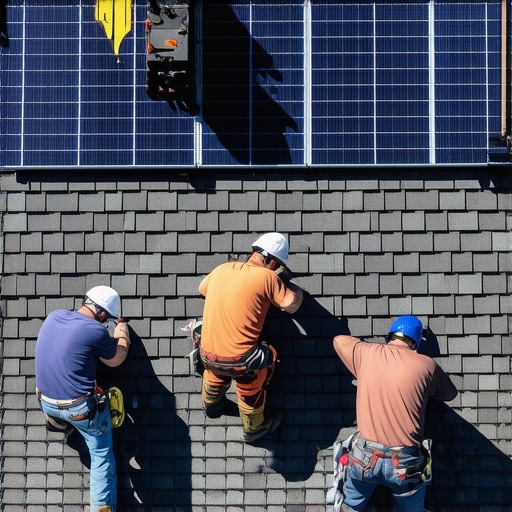
The Solar Gold Rush and the Patient Predator
My old foreman used to say, ‘Water is patient. It will wait for you to make a mistake.’ He’d say this while pointing at a tiny, poorly bent piece of step flashing that looked fine to the homeowner but looked like a neon ‘Enter’ sign to a forensic roofer like me. In 2026, as every local roofer starts pushing integrated solar shingles, those words have never been more haunting. We aren’t just talking about a roof anymore; we are talking about a 25-year marriage between high-voltage electronics and the cedar or asphalt that protects your family. Most roofing companies are rushing to get certified, but they aren’t looking at the physics of how a solar-integrated deck actually breathes. If you think a standard square of shingles is complex, wait until you see the wiring harnesses and thermal expansion loops required for a modern photovoltaic array. The problem isn’t the tech; it’s the installation. Water doesn’t care about your green energy footprint; it only cares about gravity and the capillary action that pulls it into your attic bypass.
The Physics of Failure: Why Integrated Solar Is Different
When you bolt a traditional solar rack onto a roof, you create 40 to 60 penetrations. Each one is a potential leak point, sure, but at least the shingles underneath can still shed water. With 2026-spec solar shingles, the shingle is the solar panel. This creates a unique thermal profile. In cold climates, where ice dams are the primary enemy, these panels can create ‘hot spots’ on the roof deck. Imagine a 10-degree January morning. Your attic is hopefully cool, but the solar shingle is absorbing UV and heating up. This melts the bottom layer of snow, sending water down to the unheated drip edge where it freezes solid. This isn’t just a leak; it’s a structural threat. The weight of that ice, combined with the thermal bridging of the solar connectors, can turn a standard 7/16 OSB deck into a sponge in less than three seasons. I’ve walked on decks where the integration was done by ‘trunk slammers’ who ignored the R-Value of the insulation below, and it felt like walking on a trampoline. That’s the sound of rotting plywood, and it’s a sound that costs $30,000 to fix.
“A roof is only as good as its flashing.” – Old Roofer’s Adage
The Mechanism of Capillary Action Under Solar Arrays
Let’s talk about Mechanism Zooming. Water doesn’t just fall off a roof; it crawls. Through a process called capillary action, moisture can actually move upward between two flat surfaces if the gap is tight enough. Solar shingles, being flatter and more rigid than traditional architectural shingles, are prone to this. If the head lap isn’t perfect—if the roofer was off by even a half-inch—wind-driven rain gets sucked upward, past the top of the shingle, and directly into the nail line. Once it hits a shiner (a nail that missed the rafter), it has a direct metal highway into your ceiling. I’ve seen homeowners replace their entire living room ceiling twice before they realized the problem wasn’t a hole in the roof, but a physics failure in how the solar shingles were lapped. Local roofers who don’t understand the hydrostatic pressure involved in a heavy downpour are just installing future lawsuits.
The Warranty Trap: Marketing vs. Reality
Every roofing company will tell you their solar shingles have a 25-year warranty. But read the fine print. Does the warranty cover the flashing? Does it cover the labor to tear off the solar units if the underlayment fails? Usually, the answer is a hard no. The solar manufacturer blames the roofer, the roofer blames the manufacturer, and the homeowner is left with a bucket in the kitchen. In the trade, we call this the ‘Warranty Shell Game.’ A ‘Lifetime Warranty’ is often just a marketing term that expires the moment the company sells its assets to a private equity firm. Real protection comes from Secondary Water Resistance (SWR). If your roofer isn’t talking about a full-deck coverage of Ice & Water Shield under those solar units, they are setting you up for failure. You need a substrate that can stand alone, even if every single solar shingle was removed. That is the only way to sleep through a Nor’easter.
“The application of a roof system must provide a continuous weather-tight seal from the ridge to the eave.” – International Residential Code (IRC) R903.1
Ventilation: The Silent Killer of Solar Shingles
The heat in a 140°F attic is bad enough for standard asphalt, but for integrated solar, it’s a death sentence. Solar cells lose efficiency as they get hotter. If your soffit vents are clogged or your ridge vent is undersized, that heat has nowhere to go. It bakes the shingles from below while the sun fries them from above. This leads to ‘thermal shock,’ where the material expands and contracts so violently that the adhesive bonds fail. You’ll start to see ‘cupping’ or ‘fish-mouthing’ at the edges of the solar array. Once that happens, the wind rating of your roof drops from 130mph to about 40mph. I’ve seen entire squares of solar shingles peeled off like a banana skin because the attic was essentially a pressure cooker. A true professional won’t even talk about solar until they’ve calculated your attic’s net free ventilating area.
How to Vet 2026 Roofing Companies
Don’t ask them about the solar output; ask them about the cricket. A cricket is a small diversion roof built behind a chimney or large penetration to direct water away. If a roofer can’t explain how they flash a chimney or a valley with integrated solar, they shouldn’t be on your house. Look for contractors who use stainless nails in coastal areas to prevent galvanic corrosion between the solar hardware and the fasteners. Look for guys who obsess over the drip edge geometry. If they are just ‘caulking and walking,’ they are the ‘trunk slammers’ my foreman warned me about. Caulk is a maintenance item, not a permanent waterproofing solution. If the integrity of your $50,000 solar roof depends on a $5 tube of silicone, you’ve already lost the battle against the elements. You want a roofer who understands that a roof is a system, not just a collection of parts. They should be looking at your fascia boards, your gutters, and your downspouts as part of the thermal and hydraulic management of the home.