
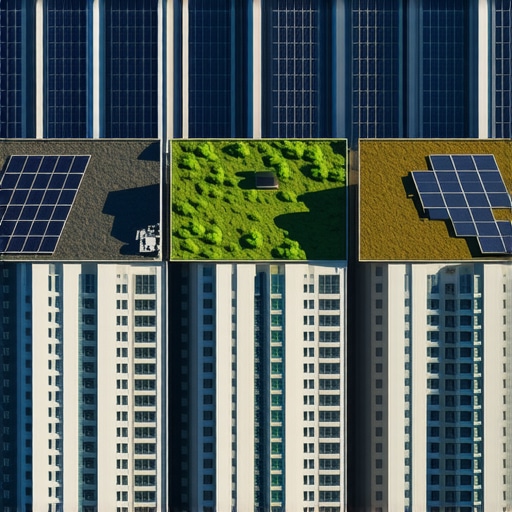
The Deception of the Green Label and the Physics of 2026 Urban Housing
If you have spent twenty-five years on a ladder, you stop seeing roofs as aesthetic choices and start seeing them as thermal battlegrounds. In the high-density apartment sector, specifically looking toward 2026, ‘eco-friendly’ is the new marketing buzzword that keeps many roofing companies in business—not because the products work, but because they fail in such fascinatingly expensive ways. I have walked over a thousand squares of multi-family roof decks where the so-called ‘green’ solutions had turned into a $200,000 liability because the installer did not understand the basic laws of thermodynamics. In the humid, salt-heavy air of coastal regions like Miami or Houston, water does not just fall; it searches. My old foreman, Sully, used to say, ‘Water is patient. It will wait for you to make a mistake.’ He was right. You can buy the most sustainable material on the planet, but if you do not understand the capillary action of wind-driven rain under a starter strip, you are just building a very expensive mold farm. Most local roofers are chasing volume, but for 2026, apartment owners need to be chasing forensic-level durability.
“The building envelope must be designed to manage moisture through the use of drainage planes, air barriers, and vapor retarders appropriate for the climate zone.” – International Residential Code (IRC) R703.1
When we talk about eco-friendly roofing for the next decade, we are looking at the ‘Mechanism Zooming’ of failure. Take, for instance, the way heat moves through a standard TPO membrane. In a dense urban heat island, the surface temperature of a dark roof can hit 170°F. This creates a massive delta-T between the roof surface and the air-conditioned plenum below. This temperature gradient forces moisture into the insulation through a process called vapor drive. If your roofing companies do not account for this with proper secondary water resistance (SWR), that ‘sustainable’ insulation will become saturated, losing its R-value and eventually rotting the deck from the inside out.
1. Bio-Based Thermoplastic Polyolefin (TPO) with Integrated PV
By 2026, standard TPO is being replaced by bio-based polymers derived from non-petroleum feedstocks. But the real ‘eco’ move is the integration of thin-film photovoltaics. From a forensic perspective, the failure point here is almost always the heat weld. A shiner—a missed nail—is bad, but a cold weld on a 200-foot run of TPO is a catastrophe. When the sun hits those panels, the thermal expansion and contraction (thermal shock) causes the membrane to ‘creep.’ If the local roofers did not use reinforced perimeter strips, the membrane will pull away from the parapet walls, creating a direct path for water to enter the building. You need a contractor who understands the molecular cross-linking of these polymers, not just someone who can drag a robot welder in a straight line.
2. Intensive Living Roof Assemblies: The Structural Load Reality
Everyone loves the look of a green roof on an apartment building, but few understand the hydrostatic pressure involved. When you have four inches of saturated soil sitting on a membrane, water is being forced downward by gravity at all times. This is not like a shingle roof where the water sheds; this is a pool. I have seen ‘eco-friendly’ green roofs where the root barrier was compromised by a single dropped utility knife during installation. Within three years, the roots had found the seams, opened them like a tin can, and started drinking from the drywall in the penthouse units. The solution for 2026 is high-density polyethylene (HDPE) drainage layers that create a clear path for water to reach the scuppers without sitting on the primary waterproofing layer. If your roofing companies aren’t talking about root-repellent chemical additives in the membrane, they are setting you up for a forensic nightmare.
3. Recycled Composite Slate: The UV Degradation Problem
Synthetic slate made from recycled tires and plastic is a great way to divert waste from landfills, but the physics of UV bombardment in the Southeast is brutal. UV rays break down the polymers, leading to ‘chalking’ and brittleness. A roof that was supposed to last fifty years can become as fragile as a potato chip in ten if the antioxidant stabilizers are cheap. When examining these systems, I look at the head lap. If the installer cheated the exposure to save on material, wind-driven rain will use capillary action to climb up the underside of the shingle and over the top of the underlayment. For 2026 apartments, we must demand ‘class 4’ impact-rated composites that utilize Kynar-based coatings to reflect the infrared spectrum, keeping the material cool and preventing the oils from gassing out.
4. High-Reflectance Standing Seam Metal with Radiant Barriers
Metal is the king of longevity, but in a tropical or high-heat zone, it is a giant radiator. The eco-friendly aspect comes from its 100% recyclability and its ability to host a radiant barrier in the attic space. However, metal has a massive coefficient of thermal expansion. A 50-foot panel can grow by an inch in the midday sun. If the roofing companies use fixed fasteners instead of expansion clips, the metal will ‘oil can’—it will buckle and twist, eventually shearing the screws right off. I have seen roofs where the fasteners were backing out like tectonic plates shifting, leaving holes large enough to put a finger through. For a 2026 apartment project, you need stainless steel fasteners to prevent galvanic corrosion between the screw and the panel, especially in salt-air environments.
“A roof is only as good as its flashing; the material is merely the field, but the joints are the battleground.” – Old Roofer’s Adage
5. Reclaimed Clay Tile and the ‘Dead Valley’ Challenge
Using reclaimed materials is the pinnacle of sustainability, but it requires an old-school craftsman’s touch. Clay tiles are heavy. I have investigated collapses where a building owner replaced asphalt with tile without reinforcing the trusses. Beyond the weight, tile roofs fail at the valleys. A ‘dead valley’—where two roof planes meet without a clear slope to the edge—is where tile roofs go to die. Debris builds up, water backs up under the tile, and the sub-roof (the real waterproofing) rots away. In 2026, we use double-layered self-adhering modified bitumen underlayment in these areas. If you see a roofer using standard #30 felt under clay tile, fire them on the spot. Felt will dry out and crack within a decade, while the tile sits on top looking perfectly fine while the plywood underneath turns to mush.
The ‘Lifetime Warranty’ Scam
Do not let a local roofer sell you on a ‘lifetime’ warranty. In the trade, we know those warranties are written by lawyers to protect the manufacturer, not the homeowner. They usually cover ‘manufacturing defects,’ which are rare. 95% of roof failures are due to poor installation—flashing that wasn’t counter-flashed, crickets that weren’t built behind chimneys to divert water, or shiners that allow a slow drip into the insulation. For 2026, the real ‘eco-friendly’ move is hiring a firm that performs infrared moisture scans and uses drone-based thermal imaging to verify the integrity of the envelope before the final payout. That is how you ensure a roof actually lasts its intended lifespan, which is the ultimate form of sustainability.
Conclusion: Choosing the Right Roofing Companies
When you are looking for local roofers for your 2026 apartment upgrades, stop asking about the price per square. Start asking about their flashing details. Ask how they handle the transition from a vertical wall to a horizontal deck. Ask about their thermal break strategies. A truly eco-friendly roof is one that you never have to replace. Every time you tear off a failed roof and send it to a landfill, you have failed the environment, regardless of how ‘green’ the replacement material claims to be. Proper ventilation, high-quality underlayment, and a forensic approach to water management are the only ways to survive the shifting climates of the next decade.