
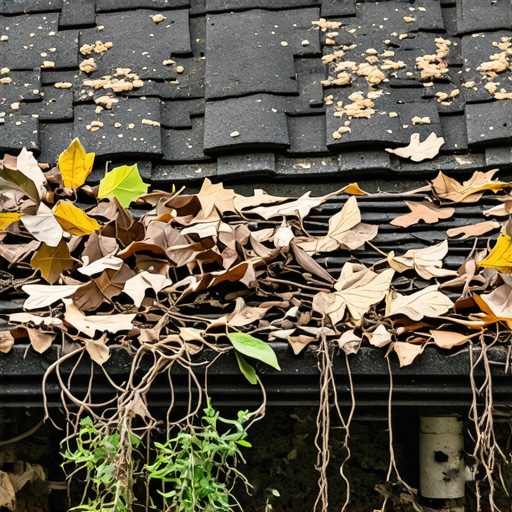
The Forensic Scene: Walking on a Sponge
Walking on that eave felt like walking on a sponge. I knew exactly what I’d find underneath before the first pry bar even touched a shingle. It was a 2026-forecasted disaster, years in the making. The homeowner thought they had a ‘lifetime’ system, but the fascia was so doughy you could put a finger through it. When roofing companies talk about 2026, they aren’t talking about futuristic tech; they’re talking about the bill coming due for the shortcut-heavy installs of the early 2020s. Water doesn’t care about your warranty paperwork; it only cares about gravity and the path of least resistance. In my 25 years as a forensic roofer, I’ve seen that path lead straight into the soffits more times than I can count.
Reason 1: The Biofilm ‘Glue’ and the Failure of 2020-Era Micromesh
The first reason your gutters are destined to fail by 2026 is the biological degradation of aftermarket guards installed during the 2020 housing boom. Many local roofers sold micromesh systems as a ‘set it and forget it’ solution. Physics begs to differ. Over five years, the fine stainless steel mesh doesn’t just catch leaves; it filters microscopic organic matter—pollen, sap, and dust. By 2026, this mixture undergoes a chemical transition into a waterproof biofilm. This isn’t just a clog; it’s a laminate. When the rain hits that biofilm, the surface tension prevents the water from dropping into the trough. Instead, the water ‘skips’ over the top of the gutter, cascading down the siding. This is the Coandă effect working against you. The water follows the curve of the mesh and high-tails it right into your foundation. You think your gutters are clean because you don’t see leaves, but your basement tells a different story.
“Gutters shall be sloped to prevent standing water and shall be supported at intervals not exceeding 48 inches.” – International Residential Code (IRC) R801.3
Reason 2: The ‘Shiner’ Epidemic and Fascia Torque
The second reason involves the structural integrity of the mounting hardware. During the labor shortages of the past few years, we saw an explosion of ‘shiners’—nails or screws that missed the rafter tails and are just hanging out in the void. By 2026, the constant freeze-thaw cycles of a northern climate will have worked those fasteners loose. In a roofing system, the gutter isn’t just a bucket; it’s a lever. When a gutter fills with heavy, wet slush or ice, it exerts tremendous torque on the fascia board. If those fasteners weren’t driven deep into the structural lumber, the weight pulls the back of the gutter away from the drip edge. This creates a hidden gap. Water now travels behind the gutter, saturating the fascia and the rafter tails. This is where the ‘sponge’ feeling comes from. You’re not just looking at a gutter cleaning; you’re looking at a structural reconstructive surgery of your roof’s edge because the original crew was in too much of a hurry to find the rafter tails.
Reason 3: Accelerated Asphalt Granule Shedding (The ‘Sandbar’ Effect)
The third factor is the specific aging cycle of shingles manufactured between 2018 and 2021. Due to supply chain fluctuations, the granule adhesion in some batches wasn’t what it used to be. By the time we hit 2026, these roofs will be at a peak shedding phase. These granules are heavy; they don’t wash away easily. They settle in the ‘valleys’ and ‘crickets’ of your roof and eventually wash into the gutter, forming what I call ‘sandbars’ at the downspout elbows. These sandbars act as a dam. When the water stops moving, the sediment drops. It’s a self-reinforcing failure loop. The more sediment you have, the slower the water moves, and the more sediment settles.
“A roof is only as good as its flashing and its ability to shed water away from the structure, not just off the deck.” – National Roofing Contractors Association (NRCA) Guidelines
This sediment doesn’t just clog the pipe; it holds moisture against the bottom of the gutter, leading to premature corrosion even in ‘seamless’ aluminum systems as the acidic nature of the decaying organic matter eats through the coating. When you hire local roofers, ask them how they handle high-capacity drainage. If they just point to a standard 5-inch K-style gutter, they are giving you a 1990s solution for a 2026 climate reality. You need 6-inch oversized systems with heavy-duty hidden hangers to withstand the flash hydrology we’re seeing now. Don’t wait until you’re staring at a puddle on your dining room table to realize your gutter system was designed for a drizzle, not a deluge.