
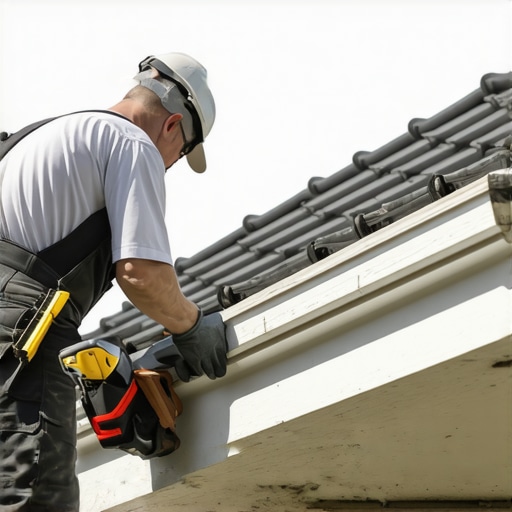
The Anatomy of a Hidden Roof Killer
Walking on that roof felt like walking on a sponge. I knew exactly what I would find underneath before I even pulled my pry bar out. The homeowner in the humid Southeast heat was complaining about a damp smell in the master bedroom, but there were no drips from the ceiling. They called three roofing companies before me, and everyone wanted to sell them a full replacement. But as I stood on the eave, I could feel the decking give way. It wasn’t a shingle failure; it was the gutter gap. That tiny, 1/4-inch space where the drip edge failed to overlap the gutter trough was siphoning thousands of gallons of water directly into the fascia and rafter tails. This is the forensic reality of many modern installs: they look great from the curb, but they are designed to fail because the physics of water tension are ignored.
The Physics of the Gutter Gap
When most local roofers install a new system, they focus on the field—the big flat areas of shingles. But the real war is won or lost at the edges. Water is a sticky substance. Thanks to surface tension, it doesn’t always just drop off the edge of a shingle. Instead, it likes to wrap around the edge and run backward. If your drip edge isn’t installed with a proper kick-out or if there is a gap between the metal flange and the gutter, that water will find the wood. It uses capillary action to climb behind the gutter and soak the fascia board. Over a single humid summer, that wood becomes a buffet for fungus. By the time you see a stain on your soffit, the structural integrity of your roof’s perimeter is already gone.
“Flashings shall be installed in a manner that prevents moisture from entering the wall and roof through joints in copings, through moisture-permeable materials, and at intersections with vent pipes.” — International Residential Code (IRC) R903.2
1. The Daylight Test: Identifying the Gap From Below
The first way to spot a 2026-standard gutter gap is to get on a ladder—safely—and look up behind the gutter trough. You should see the metal drip edge flange extending down into the gutter. If you see a sliver of wood or, worse, daylight between the back of the gutter and the roof line, you have a gap. This is often caused by roofing companies who use standard 5-inch gutters with a short-flange drip edge that doesn’t reach. In the trade, we see this when guys are trying to save three cents a foot on materials. They install a ‘D-style’ edge that is too small for the pitch of the roof. When the rain hits a heavy flow, it overshoots the gutter or wicks back into that gap. If you see any part of the wood fascia board exposed behind the gutter, your roof is effectively unsealed.
2. The ‘Shiner’ and the Stained Underbelly
The second indicator is more subtle. Look for ‘shiners’—those missed nails that went through the roof deck but missed the rafter. In the context of gutters, look at the spikes or brackets holding the trough. If you see rust streaks running down the back of the gutter or dark staining on the underside of the eave, water is bypassing the shingle starter course. Many local roofers skip the starter strip or don’t overhang the shingles by the required 1/2 to 3/4 of an inch. When the shingles are flush with the drip edge, water doesn’t break its bond with the shingle; it rolls right over the metal and into the gap. You might see a ‘tide mark’ on your fascia—a horizontal line of discoloration that proves water is sitting against the wood rather than falling into the aluminum trough. This isn’t just a leak; it is a slow-motion rot of the entire perimeter of your home.
3. The Rafter Tail Compression
The third and most severe way to identify a gap is what I call the rafter tail compression. If you grab the gutter and it feels ‘soft’ or moves when you apply light pressure, the wood behind it is already compromised. Water siphoning through the gutter gap eventually hits the end grain of your rafters. Wood is like a bundle of straws; the end grain sucks up moisture faster than any other part. When those straws get wet, they lose their ability to hold a nail or a gutter screw. If your roofing companies didn’t install a cricket to divert water or failed to bridge the gap between the roof deck and the gutter, the weight of the water-filled gutter will eventually pull the hardware through the rotted wood.
“A roof is only as good as its flashing.” — Old Roofer’s Adage
The Solution: Surgery Over Band-Aids
You can’t fix a gutter gap with a tube of caulk. I’ve seen ‘trunk slammers’ try to smear silicone in that gap, but it lasts one season before the thermal expansion of the metal tears it apart. The real fix is a ‘Gutter Apron.’ This is a specific type of flashing with a long back leg that hooks over the roof deck and extends deep into the gutter. It creates a physical bridge that water cannot get behind. If your current local roofers aren’t talking about apron flashing, they aren’t looking at the long-term health of your home. They are just looking at the shingles. You have to pull the first two courses of shingles, install the apron, and then lay a new starter course with the proper overhang. It is tedious work, which is why most companies skip it. But if you don’t do it, you’ll be replacing your fascia and soffits every five years. The cost of doing it right is a fraction of the cost of a structural repair caused by a simple 1/4-inch gap. Don’t let a sales guy in a polo shirt tell you it’s not a big deal; physics doesn’t care about a sales pitch. It only cares about the path of least resistance, and right now, that path leads straight into your attic.