
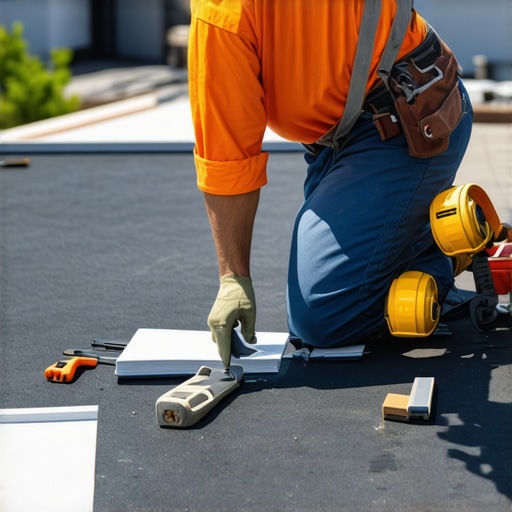
The Autopsy of a Standard Roof Failure
I stood on a roof last Tuesday in the suburbs where the homeowner was complaining about a mystery leak near the chimney. Walking on that roof felt like walking on a sponge. I knew exactly what I would find underneath before I even pulled my flat bar. When we peeled back the three-year-old architectural shingles, the plywood didn’t just look wet—it looked like it had been sitting at the bottom of a swamp. The contractor had used a cheap, non-breathable synthetic underlayment that had trapped attic moisture against the deck, essentially pressure-cooking the wood from the inside out. This is the exact catastrophe that 2026 roofing companies are finally putting to rest with the transition to Smart Mats.
The Physics of the Modern Roof Deck
For decades, we treated roofing as a simple shedding game. You put down paper, you nail down shingles, and you hope gravity does the heavy lifting. But in 2026, the local roofers who actually understand building science realize that the roof is a dynamic pressure valve. The introduction of Smart Mats has changed the ‘Material Truth’ of our industry by addressing the physics of vapor drive and capillary action. When water gets trapped under a shingle—and it will, through wind-driven rain or ice damming—it needs a way out. Standard felt just disintegrates, and early-gen synthetics act like a plastic bag. A Smart Mat, however, uses a semi-permeable membrane that allows moisture vapor to escape from the attic while remaining liquid-waterproof from the top down.
“Building enclosures should be designed to manage water, air, heat, and vapor.” – ASHRAE Fundamentals
1. Active Vapor Management and the ‘Breathing’ Deck
The first reason top-tier roofing companies have abandoned old-school felt is vapor permeability. In cold climates, warm air from your shower and kitchen migrates into the attic. If your underlayment is a total vapor barrier, that moisture hits the cold underside of the roof deck and turns into frost. When that frost melts, it rots your rafters. Smart Mats utilize a variable-permeance technology. When the deck is dry, the pores remain tight. If moisture levels rise, the material ‘opens’ at a molecular level to let the wood dry out. It’s the difference between wearing a rubber raincoat and a high-end Gore-Tex jacket while running a marathon.
2. The Self-Healing Grid Around ‘Shiners’
Let’s talk about the ‘shiner.’ That’s a trade term for a nail that misses the rafter and hangs out in the open air of the attic. Every roof has hundreds of them. In the past, every time a roofer drove a nail through the underlayment, they created a permanent hole. If water backed up under the shingles, it followed that nail shank straight into your ceiling. 2026 Smart Mats are engineered with a modified bitumen core that actually ‘clings’ to the nail. It creates a gasket-like seal the moment the steel pierces the mat. This eliminates the ‘weeping nail’ syndrome that has baffled many roofing companies for years.
3. Thermal Stability and the End of ‘Buckling’
If you’ve ever seen a roof that looks wavy or rippled in the heat of July, you’re likely looking at underlayment failure. Traditional felt absorbs water and expands, causing it to buckle and push the shingles up. Smart Mats are thermally stable up to 240°F. They don’t expand, they don’t contract, and they don’t telegraph their wrinkles through your expensive shingles. This is vital for the longevity of the roof because any ripple in the underlayment creates a pocket where wind-driven rain can pool, leading to premature granule loss on your shingles.
4. Superior Traction for Steep-Slope Safety
Roofing is dangerous work, especially when you’re dealing with a 10/12 pitch or higher. Old-school felt is notorious for tearing under a roofer’s boot, leading to catastrophic falls. Smart Mats are designed with a high-friction poly-top layer that provides grip even when damp with morning dew. For roofing companies, this isn’t just about safety; it’s about precision. A roofer who isn’t worried about sliding off the deck is a roofer who is taking the time to properly align the starter course and nail the valleys correctly.
5. Integrated Leak Detection and Smart Sensors
The ‘Smart’ in Smart Mats isn’t just marketing fluff. The high-end versions used in 2026 contain conductive threads that can detect the presence of moisture before it ever hits your drywall. These sensors can be integrated into home automation systems, notifying the homeowner of a breach after a major hail storm. This allows for ‘The Surgery’ (a small, targeted repair) rather than waiting five years for a ceiling stain to appear, which necessitates a full tear-off and deck replacement.
“The primary purpose of an underlayment is to provide a secondary weather-resistant barrier.” – NRCA Roofing Manual
6. UV Resistance During the ‘Open’ Phase
We’ve all seen those job sites where a roof stays ‘dried-in’ for weeks while waiting for the shingles to arrive or the inspector to show up. Traditional underlayments degrade under UV radiation in as little as 48 hours. They become brittle and lose their waterproofing capabilities. 2026 Smart Mats are rated for up to 180 days of direct UV exposure. This ensures that the secondary water barrier is pristine and intact when the final layer of roofing is finally installed.
7. Eliminating Galvanic Corrosion in Coastal Zones
For homes near the coast, salt air is a silent killer. It eats through standard galvanized nails and cheap underlayment staples. Smart Mats are often paired with non-corrosive adhesive strips that reduce the number of mechanical fasteners needed in critical areas like the eave and the rake. By reducing the metal count on the deck, local roofers are significantly extending the lifespan of the roof assembly in high-salt environments.
The Warranty Trap: Why Material Choice Matters
Many roofing companies will try to sell you on a ‘Lifetime Warranty.’ Here’s the cynical truth from someone who has spent 25 years on the shingles: those warranties almost never cover labor, and they definitely don’t cover the rot inside your walls caused by poor ventilation or bad underlayment. The manufacturer will simply claim the roof wasn’t installed to spec because the deck wasn’t ‘dry and stable.’ By using a Smart Mat, you are effectively insurance-proofing your home. You aren’t relying on a piece of paper from a manufacturer; you’re relying on the physics of the material to prevent the damage from ever occurring.
How to Choose the Right Local Roofers
Don’t just ask for a quote on ‘roofing.’ Ask about the underlayment system. If a contractor tells you they just use ‘standard felt’ because ‘that’s how we’ve always done it,’ run the other way. That’s the talk of a trunk-slammer who won’t be around when the leaks start in three years. You want the crew that talks about ‘perm ratings,’ ‘thermal expansion,’ and ‘deck integrity.’ The cost of a Smart Mat is a fraction of the total project, but its failure is the most expensive mistake you can make. Protect your investment by looking past the shingles and focusing on the forensic health of the entire roof assembly.