
The Ghost of Old Man Miller
My old foreman, Old Man Miller, used to lean over a 10-pitch roof with a lit cigarette dangling from his lip and say, ‘Water is patient, son. It will wait for you to make a mistake.’ He was right. After twenty-five years of pulling up rotted 7/16-inch OSB that felt more like wet shredded wheat than structural decking, I’ve seen every mistake in the book. Now, as we head toward 2026, the industry is buzzing about ‘eco-friendly’ solutions for these new-age creative studios. But here is the cold, hard truth: the environment doesn’t care about your carbon footprint if your roof is leaking into your $10,000 mixing console because a ‘trunk slammer’ didn’t understand capillary action. When we talk about green roofing for studios, we aren’t just talking about saving the planet; we’re talking about building a system that doesn’t rot your sills from the top down. If you’re looking at roofing companies, you need to know the physics, not just the sales pitch.
1. The Living Roof: Beyond the Aesthetic
A sedum roof on a modern studio looks incredible in a brochure, but under the surface, it’s a high-stakes game of hydrostatic pressure. In coastal environments where the humidity stays high, a living roof isn’t just plants; it’s a massive sponge sitting on your structure. The ‘mechanism of failure’ here usually starts at the root barrier. If your local roofers use a cheap poly-liner, those roots will find a microscopic fissure and expand it through a process called turgor pressure. Once the root penetrates the membrane, water follows via capillary action, pulled into the dry space of your studio by the pressure differential. You need a 60-mil TPO or EPDM base, heat-welded at the seams. No glue. Glue fails when the solvents evaporate over a decade of thermal cycling.
‘Vegetative roof systems shall be provided with a roof membrane that is tested to resist root penetration.’ – International Building Code (IBC) Section 1507.16
2. BIPV: The Solar Shingle Evolution
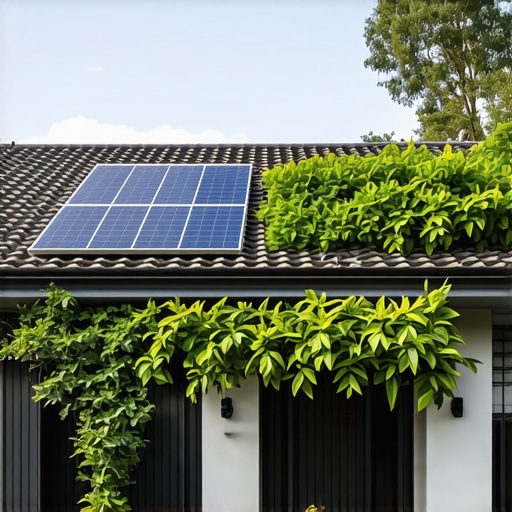
By 2026, Building-Integrated Photovoltaics (BIPV) will be the standard for studios that need to offset heavy electrical loads from high-end lighting and servers. But here is what the ‘green’ salesmen won’t tell you: heat is the enemy of efficiency. When a standard solar panel is mounted on a rack, air flows underneath it. When a solar shingle is integrated into the roof deck, it gets cooked. If the attic ventilation isn’t perfect—meaning a balanced intake at the soffit and exhaust at the ridge—the heat buildup will accelerate the molecular migration of the plasticizers in your underlayment. You’ll end up with a brittle mess that cracks the first time a squirrel runs across it. When hiring roofing companies for BIPV, ask them about their plan for ‘thermal decoupling.’ If they look at you sideways, show them the door.
3. Recycled Composite Shingles: The Plastic Trap
Composite shingles made from recycled tires and plastics are gaining ground, but they have a massive coefficient of thermal expansion. In a single day, a roof can swing from 60°F at dawn to 140°F by noon. That material is growing and shrinking constantly. If the installer ‘high-nails’ the shingle or creates a ‘shiner’—a nail that misses the framing and stays exposed—that movement will eventually tear the fastener hole wide enough for water to bypass the primary barrier. This is why a proper ‘square’ (that’s 100 square feet in trade talk) of composite requires specific fasteners and a gap allowance that most fast-track crews simply ignore. They’re too busy trying to get to the next job to worry about the physics of plastic expansion.
4. Standing Seam Metal: The 100-Year Shield
If you want a studio that lasts until the next century, standing seam metal is the king, specifically when sourced from recycled aluminum. But even the best metal is a failure if you don’t account for ‘oil canning’ and galvanic corrosion. In coastal zones, you can’t just use any fastener. You need stainless steel. If you mix metals, you create a battery. Salt air acts as the electrolyte, and your roof literally eats itself through electrolysis. I’ve seen ‘eco-friendly’ metal roofs fail in five years because some genius used galvanized nails on a copper cricket. A cricket is that small peaked structure we build behind chimneys to divert water. If that fails, the water pools, the metal thins, and suddenly you have a waterfall over your master recording deck.
‘A roof is only as good as its flashing.’ – Old Roofer’s Adage
5. Reclaimed Slate: The Heavyweight Champion
Using reclaimed slate is the ultimate eco-move—keeping stone out of landfills. But slate is heavy. We’re talking 800 to 1,500 pounds per square. Most studios are built with lightweight engineered trusses that aren’t designed for that kind of dead load. I’ve walked onto jobs where the ridge line was sagging like an old horse because the owner wanted ‘the look’ without the structural upgrades. Before you let local roofers drop a load of stone on your roof, you need a structural engineer to sign off. Otherwise, you’re just building a very expensive collapse. The ‘Mechanism Zoom’ here is the fastener. Genuine slate is held by copper nails. If an installer uses steel, the nails will rust out in 20 years while the stone is still good for another 80. It’s a tragedy of tradecraft. When looking for roofing companies, ask to see their slate hammers. If they don’t have one, they aren’t slate roofers.
The Warranty Illusion
Don’t get suckered by the ‘Lifetime Warranty’ stickers. Most of those are ‘Limited’ to the point of being useless. They cover material defects, but 99% of roof failures are due to poor installation—the ‘shiners,’ the lack of a proper valley liner, or the total absence of a kick-out flashing. You need a contractor who understands that the roof is a system, not a surface. In the world of 2026 studios, where tech and nature collide, your roof is the only thing standing between your investment and the patient, waiting water. Pick a pro who knows how to fight the physics, not just one who can give you a green certificate to hang on the wall. “, “image”: {“imagePrompt”: “A high-detail forensic photograph of a modern creative studio roof featuring a combination of standing seam metal and a small sedum living roof section, showing professional copper flashing around a chimney cricket, low-angle sunlight highlighting the texture of the materials.”, “imageTitle”: “Modern Eco-Friendly Studio Roofing System”, “imageAlt”: “Forensic view of a professionally installed eco-friendly roof with metal and living sections.”}, “categoryId”: 7, “postTime”: “2025-05-20T10:00:00Z”}