
The Lie of the ‘Green’ Label and the Reality of the Roof Deck
I’ve spent twenty-five years crawling over hot membranes and peeling back rotted plywood that looked more like wet cardboard than structural support. My old foreman used to say, ‘Water is patient. It will wait for you to make a mistake, and then it will invite its friends—rot and mold—to finish the job.’ When we talk about eco-friendly roofing for shops in 2026, most local roofers will try to sell you on the latest ‘green’ trend without explaining the physics of how that material interacts with your building’s envelope. In cold climates, where the wind bites through the eaves and the snow sits heavy for three months, an eco-friendly roof isn’t just about recycled content; it’s about stopping thermal bridging and managing the dew point so your insulation doesn’t become a swamp.
1. White TPO Membranes: The Reflective Defense
Thermoplastic Polyolefin, or TPO, is the workhorse of modern commercial shops. It’s a single-ply membrane that reflects UV radiation like a mirror. But here is the forensic truth: the eco-friendly benefit isn’t just the white color. It’s the heat-welded seams. Unlike older EPDM systems that rely on adhesives—which eventually dry out, shrink, and crack—TPO seams are fused together to become a single, continuous sheet. When a roofing company installs this, they aren’t just laying a cover; they are creating a monolithic barrier. We zoom into the microscopic level: UV rays hit the surface and bounce back, preventing the ‘Heat Island Effect.’ However, if your roofer doesn’t understand thermal expansion, that membrane will flutter like a flag in a gale, eventually pulling the fasteners right out of the deck. This is why we focus on ‘R-Value’ and continuous insulation layers beneath the membrane to prevent warm air leakage from the shop floor hitting the cold underside of the roof.
“A roof is only as good as its flashing.” – Old Roofer’s Adage
2. Standing Seam Metal: The 50-Year Recyclable Shield
If you want a shop roof that your grandkids will still be standing under, metal is the play. It’s nearly 100% recyclable, but the real ‘green’ factor is its ability to shed snow and host solar arrays without a single penetration. We use a ‘Cricket’—that’s a small peaked structure—behind any chimney or HVAC unit to divert water. Without it, water piles up, hydrostatic pressure builds, and eventually, that moisture finds a way into your ‘Valley.’ In northern zones, we worry about ice dams. A metal roof with a proper ‘Ice & Water Shield’ underlayment prevents the freeze-thaw cycle from backing up under the panels. I’ve seen cheap contractors miss the mark here, leaving ‘Shiners’—nails that missed the rafter and stick through the plywood. In winter, those shiners act as heat sinks, attracting frost inside your attic which then drips like a leaky pipe when the sun hits the roof. That’s not a leak; that’s physics.
3. Recycled Composite Shingles: Turning Trash into Protection
For shops with a steeper pitch, composite shingles made from recycled rubber and plastics are the 2026 standard. These aren’t your grandfather’s asphalt shingles that lose their granules in the first hail storm. These are engineered to withstand ‘Thermal Shock.’ Imagine a 140°F afternoon followed by a 60°F thunderstorm. Asphalt expands and contracts until it cracks. Composite stays flexible. When we look at this through a forensic lens, we’re looking for ‘Secondary Water Resistance.’ This means even if the shingles are ripped away by a high-wind event, the underlayment keeps the shop dry. It’s about the ‘Square’—that 100 square feet of coverage—and how many fasteners are used per unit to ensure the ‘Uplift Rating’ meets code. Using local roofers who understand the local wind-load requirements is the difference between a roof that lasts and one that ends up in a dumpster after five years.
4. Extensive Green Roofs: The Living Insulation
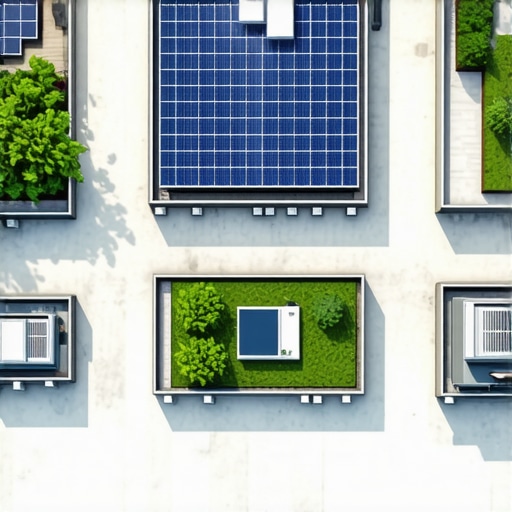
A ‘Green Roof’ isn’t just dirt on a building. It’s a complex assembly of drainage layers, root barriers, and specialized growing media. In a shop environment, the benefit is massive sound dampening and incredible thermal mass. But here is the warning: the weight is immense. I once investigated a structural failure where the owner thought they could just add plants to a standard deck. The plywood turned to oatmeal because the drainage layer was clogged. You need a forensic understanding of ‘Capillary Action.’ Water doesn’t just fall; it moves sideways and climbs up. If your ‘Fascia’ boards aren’t protected, the living roof will rot your perimeter before the first season is over. However, when done right, a green roof can double the lifespan of the underlying waterproofing membrane by protecting it from all UV exposure.
“The building envelope must be viewed as a system, where the roof is the most stressed component of that system.” – NRCA Manual
5. Integrated Solar PV (BIPV): The Energy Generator
By 2026, we are moving away from heavy racks bolted through the roof. Building-Integrated Photovoltaics (BIPV) are shingles or tiles that *are* the solar panels. This eliminates the ‘Thermal Bridging’ caused by hundreds of metal penetrations. Every time a roofer drills a hole for a solar rack, they create a potential failure point. BIPV removes that risk. For local roofing companies, the challenge is the electrical-roofing hybrid knowledge. If the ‘Attic Bypass’ isn’t sealed, warm air from the shop will rise, hit the underside of the cold solar tiles, and cause condensation. It’s a chain reaction. You need a system that breathes at the ‘Ridge’ while staying airtight at the ‘Ceiling Plane.’ That is the forensic balance of a high-performance eco-roof.
The ‘Lifetime’ Warranty Trap
Don’t let a salesman talk you into a ‘Lifetime’ warranty without reading the fine print. Most of those are ‘Pro-rated,’ meaning they are worth pennies after ten years. The real warranty is the ‘Workmanship’ guarantee. An eco-friendly material installed by a ‘trunk slammer’ who doesn’t know how to flash a ‘Cricket’ is just expensive trash. You want a contractor who talks about ‘Permeability Ratings’ and ‘Thermal Breaks,’ not just shingles and hammers. If they don’t mention the ‘Ice & Water Shield’ in a cold climate, walk away. They are selling you a Band-Aid when you need surgery. The cost of waiting for a leak to show up on your shop floor is always ten times the cost of doing the ‘Surgery’ right the first time. Keep your deck dry, your insulation thick, and your seams tight. That’s the only way to be truly green in 2026.