
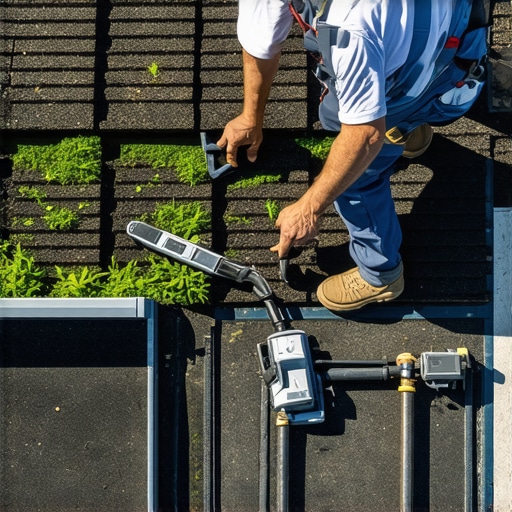
The Invisible Enemy: Why Your Roof Is Turning Into a Petri Dish
Walk outside and look at your roof. Do you see those long, dark streaks that look like charcoal soot running down the shingles? Most homeowners think that’s dirt or maybe a little bit of pollution from the nearby highway. They’re wrong. As a forensic roofer with 25 years spent crawling over damp plywood and sweltering ridge vents, I can tell you exactly what you’re looking at: Gloeocapsa magma. It’s a hardy, ancient cyanobacteria that doesn’t just sit on your roof; it feasts on it. My old foreman, Pete, used to say, ‘Water is patient, but algae is hungry. It’ll wait for you to make a mistake, then it’ll eat your house while you’re sleeping.’ Pete was a cynical old bird, but he was right. These streaks are the byproduct of bacteria feeding on the limestone filler that modern manufacturers pump into asphalt shingles to save a buck on weight and fire ratings. If you’re planning for 2026, you need to understand that local roofers are changing their tactics because the humidity is only getting worse.
“A roof is only as good as its flashing—and its ability to shed more than just water.” – Old Roofer’s Adage
1. The Science of Metallic Ionization: Beyond the Simple ‘Zinc Strip’
Back in the day, we’d just nail a strip of zinc at the ridge and call it a day. In 2026, professional roofing companies are getting more surgical. The mechanism here is simple physics: when rainwater hits a metallic strip (copper or zinc) at the peak of a square, it creates a chemical reaction. This releases metallic ions that wash down the slope. These ions are toxic to algae but harmless to your lawn. However, the ‘trunk slammers’ usually install these strips wrong. They tuck them too far under the ridge cap, or they use cheap galvanized steel that rusts out in three seasons. A real pro ensures the strip has at least two inches of exposure to maximize the ‘wash-down’ effect. We’re talking about creating a permanent biocidal shield that works every time it drizzles. If your roofer isn’t talking about the galvanic scale, they’re just guessing.
2. Copper-Infused Granule Technology and the 2026 Standard
Manufacturing has evolved. The top-tier roofing companies are now pushing shingles with advanced copper-infused granules. This isn’t just a coating; it’s baked into the ceramic. These granules utilize a timed-release mechanism. Think of it like a slow-release fertilizer, but for killing bacteria. The problem we’ve seen in the field is that ‘Algae Resistant’ (AR) shingles from ten years ago only had a 5-year efficacy. By the time 2026 rolls around, those old roofs will be completely green. The new generation of shingles uses a higher concentration of copper and a more porous ceramic shell to ensure that even in a low-slope valley where water tends to linger, the algae can’t get a foothold. When you’re vetting local roofers, ask them about the ‘Blue-Green’ warranty. If they can’t explain how the copper stays active for 25 years, they’re selling you a basic 3rd-tab shingle dressed up as premium tech.
3. Vapor Drive and the Attic Ventilation Equation
Algae doesn’t just need food (limestone); it needs a specific temperature and moisture profile. This is where most roofing companies fail. They focus on the top of the shingle, but the real war is won in the attic. If your attic is a 140°F swamp, that heat transfers through the deck and creates a warm, humid microclimate on the surface of the shingle. This accelerates the life cycle of Gloeocapsa magma. We look for ‘thermal bridging’—places where heat escapes your home and warms the roof deck. By installing a balanced system of soffit vents and ridge vents, we drop the deck temperature. This prevents the ‘dew point’ from hovering on your roof surface for four hours every morning. You want that roof bone-dry by 9:00 AM. If there’s a cricket diverting water around a chimney, we make sure the airflow behind it isn’t dead. Dead air equals green slime.
“Design for the water you can’t see, because that’s the water that will rot your rafters.” – Old Roofer’s Axiom
4. The Death of Pressure Washing and the Rise of Soft-Wash Maintenance
I’ve seen more roofs destroyed by ‘power washers’ than by hurricanes. You see a guy with a pressure wand and a ladder, you run the other way. High-pressure water blasts the granules right off the asphalt, exposing the bitumen to UV rays. That’s a death sentence for a roof. In 2026, the best roofing companies are implementing ‘Soft-Wash’ maintenance programs. This involves a low-pressure chemical application—usually a sodium hypochlorite blend with a surfactant—that kills the algae at the root without disturbing the starter strip or the integrity of the shingles. It’s like surgery versus a sledgehammer. Professional roofing is moving toward a service model where we treat the roof every three to five years to ensure the biofilm never starts. If you wait until you see the black streaks, the bacteria has already eaten 10% of your shingle mass. You’re not just cleaning; you’re performing a forensic rescue mission.
The Trap: Why Your ‘Lifetime Warranty’ Won’t Cover This
Don’t get cute with the fine print. Most manufacturers consider algae growth an ‘aesthetic’ issue, not a functional defect. This means your 50-year warranty is worthless when the HOA starts sending you nasty letters about your green roof. When you hire local roofers, you need to demand a labor-backed guarantee specifically for algae mitigation. If they aren’t willing to stand behind the physics of their installation, they’re just another crew of ‘shingle-chuckers’ looking for a quick check. Roofing in the humid Southeast or the rainy Northwest is a game of managing moisture at the microscopic level. You don’t need a salesman; you need a technician who knows why that north-facing slope looks like a forest floor. Invest in the metallic ions, the copper-infused granules, and the ventilation today, or you’ll be paying for a premature tear-off by 2030.
This article really highlights how crucial it is to take proactive measures to prevent algae growth on roofs, especially with the increasing humidity and changing standards by 2026. I was surprised to learn how many homeowners underestimate the importance of attic ventilation in controlling surface humidity. Years ago, I didn’t think much about attic health, but after my last home inspection where I found poor ventilation leading to moss and algae buildup, I realized how much impact it has. The mention of installing copper or zinc strips correctly and ensuring at least two inches of exposure is a good practical tip. I also appreciate the emphasis on soft-wash treatments; I’ve seen pressure washing damage shingles firsthand. It makes me wonder—what other innovative solutions are emerging for long-term algae prevention that we haven’t heard about yet? Are there new materials or tech that could further improve how we protect our roofs from these microscopic invaders? It’s exciting to see how technical advancements are moving toward better maintenance and preservation strategies.