
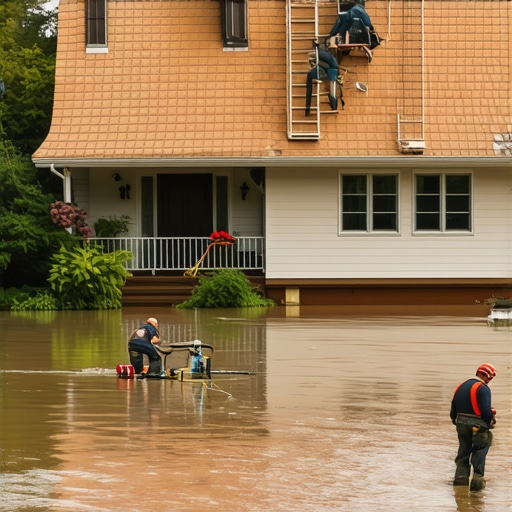
The Forensic Reality of a Saturated Roof Deck
Walking on that roof felt like walking on a sponge. I knew exactly what I’d find underneath. After twenty-five years in the trade, your boots tell you more than your eyes ever could. In the wake of the 2026 floods, the local roofing industry has been pushed to a breaking point. We aren’t just seeing leaks; we are seeing systemic structural failures where the water doesn’t just drip—it flows. When the clouds dump ten inches of rain in a single afternoon, the physics of your roof change. Water stops behaving like a shedding liquid and starts behaving like a hydrostatic weight. If your local roofers haven’t explained the difference between gravity-fed drainage and hydrostatic pressure, you’re already behind the curve.
Most roofing companies are currently swamped with calls, but the difference between a veteran crew and a ‘trunk slammer’ is how they handle the emergency. A rookie throws a blue tarp over a valley and calls it a day. A forensic roofer looks for the shiner—that missed nail in the attic that is currently acting as a lightning rod for moisture, guiding water directly into your insulation. This is the reality of the 2026 weather patterns: the volume of water is so high that traditional ‘shedding’ mechanics are failing. We are seeing water crawl uphill through capillary action, defying gravity because the surface tension of the rain is being pushed by 60-mph gusts. It’s a mess, and if you don’t fix it right the first time, you’ll be replacing every square of plywood by next season.
“Roofing systems should be designed to shed water rapidly and prevent its accumulation.” – National Roofing Contractors Association (NRCA)
Fix 1: The Weighted Ballast Tarping Method
When the rain is relentless, you can’t just nail down a tarp. If you do, the wind will catch the edges, turn the tarp into a parachute, and rip the remaining shingles right off the deck. Professional local roofers use what we call the ballasted method during active floods. This involves using sandbags or heavy-duty rubber mats to weigh down the tarp edges, combined with furring strips that are screwed—not nailed—into the rafters. We look for the cricket—that small peaked structure behind a chimney—because that’s where the water is currently damming up. If the tarp doesn’t clear the cricket, you’re just creating a swimming pool on your roof. The smell of rotting OSB is something you never forget, and it starts within 48 hours of a botched tarp job.
Fix 2: Liquid Applied Membrane for Flashings
Traditional asphalt plastic cement is useless when the substrate is soaking wet. During the 2026 floods, the pros shifted to high-solids silicone or PMMA liquid membranes that can actually displace water. We see failures at the chimney flashing and the valley transitions because the metal has expanded and contracted so many times it has broken the seal. I’ve seen roofing systems where the water was literally being sucked behind the counter-flashing due to the pressure differential. By applying a liquid membrane, we create a temporary gasket that holds even when the wind is trying to shove water into your attic bypasses. It’s not pretty, but it stops the bleeding until the sun comes out and we can do a proper ‘surgery’ on the masonry.
“The roof covering shall be installed in accordance with this code and the manufacturer’s installation instructions.” – International Residential Code (IRC) Chapter 9
Fix 3: Diverting the ‘Valley’ Torrent
Valleys are the highways of your roof. In a flood, they become rivers. If your local roofers didn’t install a proper W-valley or a heavy-duty ice and water shield as a secondary barrier, the water is likely overshooting the flashing and hitting the fascia board. An emergency fix involves installing temporary diversion baffles. These are essentially metal or heavy plastic shields that force the water to stay within the valley center rather than splashing up under the shingle courses. I once tore off a roof where the contractor had missed the valley centerline by two inches, and every drop of rain for five years had been hitting the bare wood. By the time I got there, the plywood was as soft as wet cardboard. In 2026, you don’t have five years; you have five days before the mold takes over.
Fix 4: Sealing the ‘Shiners’ and Nail Pops
Under the extreme heat of the previous summers followed by the 2026 deluge, we are seeing a massive increase in nail pops. The thermal expansion of the wood deck pushes the nail up, lifting the shingle and breaking the thermal seal. Each one of these is a ‘shiner’—a silver tip of a nail reflecting your flashlight in the attic. During a flood, these act as conduits. An emergency fix involves a high-pressure injection of specialized sealant directly into the nail hole from the underside, or a ‘top-cap’ seal if the roofer can safely get on the pitch. It sounds minor, but five hundred shiners on a twenty-square roof is equivalent to leaving a window open in a rainstorm. You have to be meticulous. Roofing companies that rush this part are the ones who get sued when the ceiling collapses two weeks later.
[IMAGE_PLACEHOLDER]
The Cost of the Quick Fix
The biggest trap homeowners fall into during these floods is hiring the first guy with a ladder and a truck. True roofing expertise is forensic. It’s about understanding why the water moved sideways instead of down. If you’re in a high-wind, high-moisture zone, you need to ensure your contractor isn’t just slapping on more shingles. They need to check the starter strip, the drip edge, and the ventilation. If your attic is 140°F because the vents are clogged, that moisture from the leak is going to turn into a steam room, rotting your rafters from the inside out. The 2026 floods are a wake-up call. Your roof isn’t just a lid; it’s a complex system of fluid dynamics. Don’t let a ‘cheap’ fix turn into a $40,000 structural rebuild. Pay for the expertise now, or pay for the demolition later.