
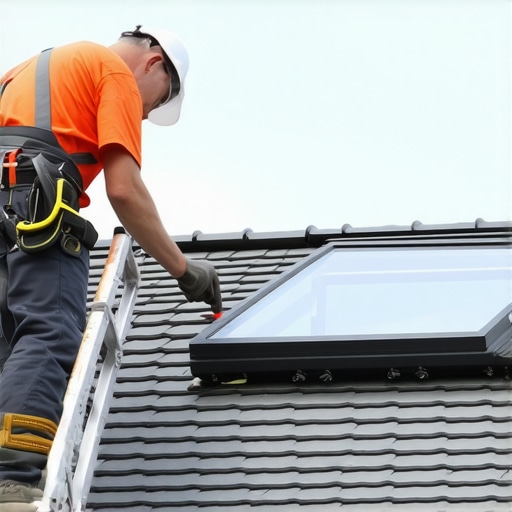
The Anatomy of a Failed Skylight: Why Your Ceiling is Crying
Walking on that roof felt like walking on a sponge. I knew exactly what I’d find underneath before I even pulled my pry bar out of my belt. The shingles looked fine from the curb, but the structural integrity was gone. This is the reality of a skylight leak in our variable climate—it is never just a drip. It is a slow-motion forensic crime scene where physics and gravity conspire against your living room. When a homeowner calls me about a ‘small damp spot’ near their skylight, they are usually seeing the final stage of a multi-year failure. By the time the water hits your drywall, it has already bypassed the shingles, saturated the underlayment, and turned your plywood deck into something resembling wet cardboard.
The Physics of Failure: Why Skylights Hate Gravity
To understand the fix, you have to understand the failure. A skylight is essentially a giant hole cut into a perfectly good watershed. The industry treats them like windows, but they are actually part of the roof drainage system. In 2026, we are seeing a massive influx of failures from installations done during the housing boom of the early 2020s. These ‘trunk slammer’ specials often ignored the fundamental law of hydrostatic pressure. When water hits the top edge of a skylight, it shouldn’t just run around it; it needs to be diverted. If your roofer didn’t install a proper cricket or a wide enough head flashing, that water pools. Once it pools, it finds its way in via capillary action—the phenomenon where liquid travels uphill between two tight surfaces, like a shingle and a piece of metal. It defies gravity, and it destroys homes.
“A roof is only as good as its flashing; if the transition between materials is not mechanically sound, no amount of sealant will save the structure.” – Old Roofer’s Adage
Fix #1: The Surgical Sealant Injection (The Band-Aid That Works)
Local roofers often get called out for a quick fix when the budget doesn’t allow for a full tear-off. The most common ‘fast’ fix involves addressing the glass-to-frame seal. Over time, the UV radiation in our region bakes the gaskets until they become brittle. When the sun goes down and the temperature drops 30 degrees, the aluminum frame contracts faster than the glass. This thermal expansion and contraction creates a microscopic gap. A pro won’t just slap some cheap hardware store silicone on it. They use a high-grade tri-polymer sealant that stays flexible at -20°F and doesn’t melt at 140°F. They clean the channel with denatured alcohol, remove the old ‘crust,’ and inject the sealant deep into the curb. It is a temporary measure, sure, but if done with precision, it can buy you another three seasons of dry ceilings.
Fix #2: Clearing the Valley and Resetting the Step Flashing
The second fast fix focuses on the debris trap. Skylights are magnets for pine needles, leaves, and grit from asphalt shingles. This junk builds up in the side channels, creating a dam. When the next heavy rain hits, the water can’t flow down the valley next to the curb. Instead, it backs up over the top of the step flashing. I have seen countless ‘leaks’ that were nothing more than a maintenance issue. Local roofing companies will pull the shingles surrounding the unit, clear the muck, and inspect for shiners—nails that were driven too low or missed the rafter, leaving a direct path for water to follow the metal down into the attic. If the flashing is bent or corroded, we swap it out for heavy-gauge aluminum or copper, ensuring each piece overlaps the one below it by at least four inches to combat wind-driven rain.
Fix #3: The Membrane Wrap (Addressing the Underlayment Gap)
If the leak is coming from the corners, the issue is likely the ‘interface.’ Most local roofers in 2026 are finding that older installations skipped the ice and water shield wrap. The third fast fix is more of a mini-surgery. We strip the shingles back two feet in every direction. We then apply a self-adhering polymer-modified bitumen membrane directly to the roof deck and up the sides of the skylight curb. This creates a secondary water barrier. Even if the shingles fail or a square of roofing gets ripped off in a storm, the membrane keeps the house dry. This is especially critical in cold climates where ice dams can push water under the shingles. Without this membrane, you’re just praying that a piece of thin felt paper can hold back a gallon of slush. It can’t.
“Flashings shall be installed in a manner that prevents moisture from entering the wall and roof through joints in copings, through moisture-permeable materials and at intersections with parapet walls and other penetrations.” – International Residential Code (IRC), Section R903.2
The Reality Check: When Fast Isn’t Enough
I’ve spent 25 years on ladders, and I’ll tell you straight: a fast fix is a stay of execution. If your skylight is more than 15 years old, the insulated glass unit (IGU) has likely lost its seal. You’ll see fogging between the panes. At that point, the structural integrity of the frame is usually compromised. You can throw all the sealant and flashing you want at it, but you’re just polishing a sinking ship. A reputable roofing company will tell you when it’s time to stop patching and start replacing. Don’t let a ‘cheap’ contractor talk you into a $500 patch on a unit that needs a $2,000 replacement; you’ll just end up spending $2,500 over two years and still have a stained ceiling. Respect the water, understand the physics of your roof, and for heaven’s sake, keep your gutters and skylight channels clear of muck.